Why Bitcoin Stalled Before Jackson Hole — This Year's Theme Is Different
Bitcoin gained 25% in August but could not hold above $80,000. This year's Jackson Hole theme puts digital payments at the centre for the first time.

The White House / Wikimedia Commons (kamu malı)
Bitcoin rose 25% through August, failed to hold above $80,000, and has settled into a narrow range going into the Jackson Hole symposium. As of 27 August, 10:25 UTC it trades at $79,807, up 1.56% over 24 hours. What the market is waiting on is not a rate decision — it is this year's theme.
- Bitcoin $79,807 · €68,526 — market capitalisation $1.60 trillion.
- August gain of 25%, the strongest August since 2017.
- Jackson Hole runs 27–29 August; the theme is "Financial Innovation: Implications for Payments and Policy".
- Fed Chair Kevin Warsh speaks on the morning of 28 August — he took office on 22 May 2026, so this is his first Jackson Hole address.
The $80,000 level was tested during the month but not held; leveraged positions unwound after an inflation release and the price gave the level back. What is on screen now is not a decline but a compression of volatility — the market is waiting for a catalyst to pick a direction.
| Bitcoin | Value |
|---|---|
| Price (USD) | $79,807 |
| Price (EUR) | €68,526 |
| 24-hour change | +1.56% |
| Market capitalisation | $1.60T |
| August performance | +25% |
Why this Jackson Hole is different
Jackson Hole is normally read as a rates event: the market parses the chair's sentences for the path of policy. This year the equation changed, because the symposium's academic theme is "Financial Innovation: Implications for Payments and Policy". For the first time in the event's history, digital payments and financial technology sit at the organising centre of the programme.
That distinction matters for crypto. The rate path affects Bitcoin through liquidity; a payments-and-innovation theme goes straight to the regulatory frame — stablecoins, tokenised deposits, payment rails, settlement systems and central-bank oversight. Around 120 central bankers and regulators from more than 70 countries are attending.
That Warsh will give his first Jackson Hole address since taking office on 22 May 2026 widens the uncertainty: the market has no settled reference for his tone on this subject. That is what the compression is about — the price is waiting on a frame nobody has heard yet.
What happens next
Three things to watch. First, whether the address frames digital assets as an area to be regulated or as a source of risk. Second, whether any concrete timetable is offered on stablecoins and tokenised deposits. Third, whether $80,000 is retested after the speech — a level lost once in the month is a stronger signal on the second attempt.
Frequently asked questions
What is Bitcoin's price today?
When is Jackson Hole and when does Warsh speak? The symposium runs 27–29 August. Fed Chair Kevin Warsh speaks on the morning of 28 August.
When is Jackson Hole and when does Warsh speak?
Why does Jackson Hole matter for Bitcoin? This year's theme is "Financial Innovation: Implications for Payments and Policy". For the first time the event places digital payments at its centre, and stablecoin and tokenised-asset regulation sit directly under that heading.
Why does Jackson Hole matter for Bitcoin?
How much did Bitcoin gain in August? Roughly 25% — the strongest August since 2017.
How much did Bitcoin gain in August?
If you are following this: what technical indicators say about Bitcoin and which indicators actually matter extend this picture.
Sources
Related News

Crypto Today: Strategy pauses BTC buys after $2B raise
Strategy raised about $2 billion through share sales, created a $1.6 billion cash reserve and did not add to its Bitcoin stash. Pakistan also set a licensing deadline for crypto firms.
Fed study links crypto demand to investor beliefs
A Federal Reserve Bank of Cleveland working paper says crypto buyers hold very different views on risk and returns, and that Bitcoin gain news can lift both intended allocations and actual purchases.
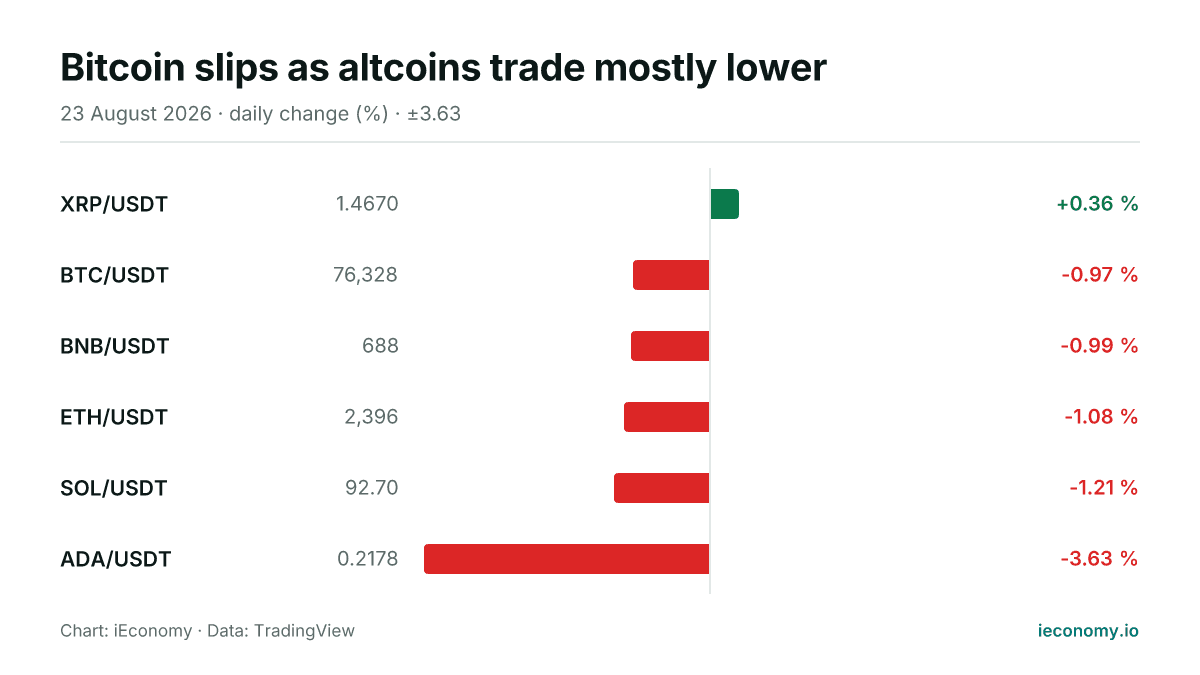
Bitcoin slips as altcoins trade mostly lower
Crypto markets were mixed on Sunday, with bitcoin, ether and most large-cap altcoins easing while XRP posted a modest gain. ADA led losses, highlighting how sentiment can diverge sharply across tokens even in a thin, round-the-clock market.

XRP Jumps on Regulatory Clarity Following Landmark Court Ruling
The token posted its sharpest gain in months after a legal decision reduced uncertainty around its regulatory classification.

Bitcoin Holds $64K as Hormuz Deal Bets Lift Stocks
Bitcoin edged higher above $64,000 while hopes that oil traffic through the Strait of Hormuz could resume lifted equities, pushing the S&P 500 to a $70 trillion market value.
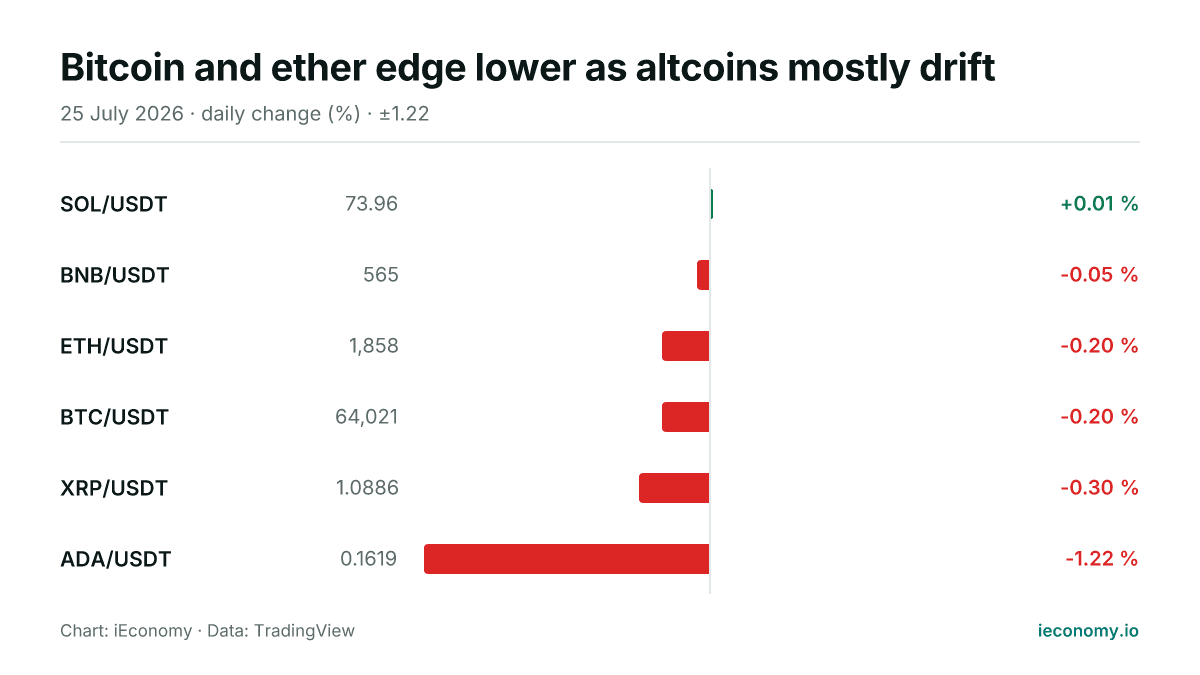
Bitcoin and ether edge lower as altcoins mostly drift
Crypto traded subdued on Saturday, with one large-cap token slightly higher and the rest either modestly lower or nearly unchanged. Bitcoin and ether both slipped 0.20%, while Cardano lagged the pack and Solana was effectively flat.