S&P 500 edges higher as leadership stays narrow
The S&P 500 finished Tuesday at 7,677.28, up 0.32%, with a split showing among the eight tracked constituents. NVDA led the gainers while XOM was the weakest name.
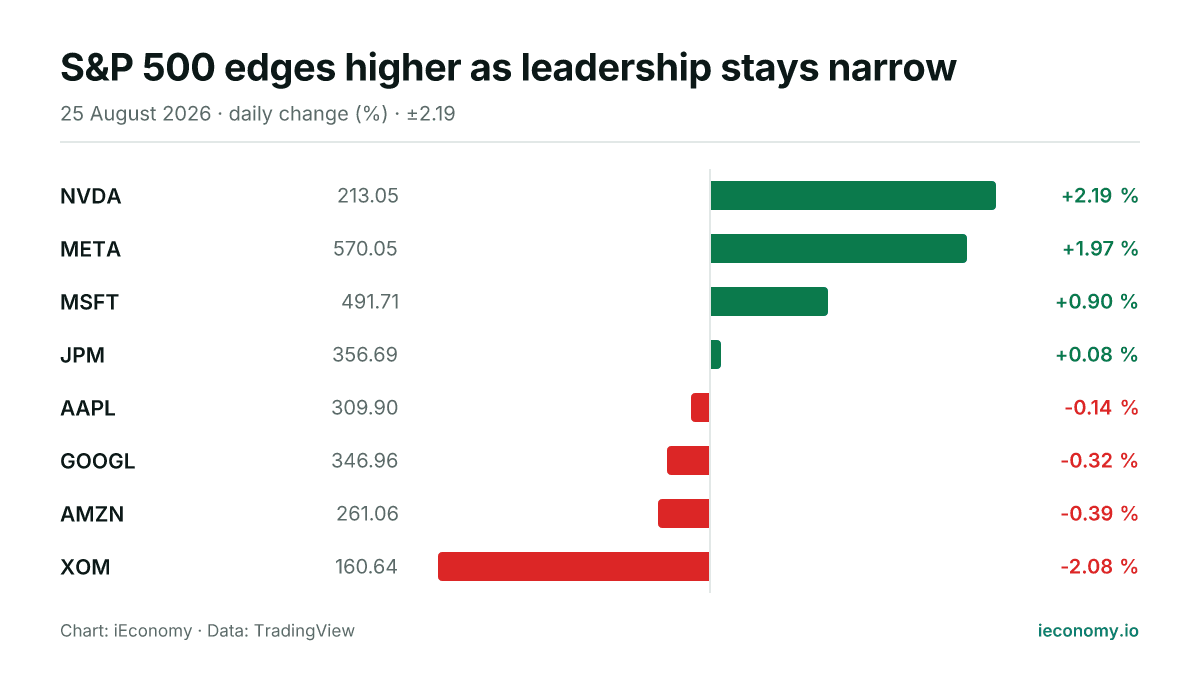
Chart: iEconomy · Data: TradingView
The S&P 500 rose 0.32% on Tuesday to 7,677.28. Among the eight constituents tracked in the digest, four finished higher and four lower, pointing to a balanced but not especially broad session.
How the index moved and how broad the move was
The day’s advance was modest, with the index edging up rather than extending sharply in either direction. That kind of move usually reflects a market where buying and selling are both present, and neither side is dominant enough to set a clear trend.
| Stock | Last | Change |
|---|---|---|
| NVDA | 213.05 | +2.19 % |
| META | 570.05 | +1.97 % |
| MSFT | 491.71 | +0.90 % |
| JPM | 356.69 | +0.08 % |
| AAPL | 309.90 | -0.14 % |
| GOOGL | 346.96 | -0.32 % |
| AMZN | 261.06 | -0.39 % |
| XOM | 160.64 | -2.08 % |
Breadth was even on the limited set of names tracked, with four gainers and four decliners. In practical terms, that means the index rise was not driven by a sweeping advance across the board, but by enough support in key holdings to keep the benchmark in positive territory.
The standout individual performers
NVDA was the strongest performer in the group, ending at 213.05 after a 2.19% gain. On a session like this, a leading stock can matter disproportionately because large-cap moves can help offset weakness elsewhere in the index.
XOM was the weakest name, closing at 160.64 after falling 2.08%. The contrast between the best and worst performers underlines that even when the headline index moves higher, individual components can still show very different trading patterns.
What a long-term investor should take from one session
A single day’s move tells investors more about short-term positioning than about the underlying long-term trajectory. A mild rise in the index with split breadth suggests the market is still being set by stock selection and weighting effects rather than a uniform move across constituents.
For long-term holders, the main lesson is mechanical: index performance can improve even when several names fall, and conversely it can weaken despite pockets of strength. That is why one session should be read as part of a wider sequence, not as a standalone verdict on risk or value.
Sources
Related News
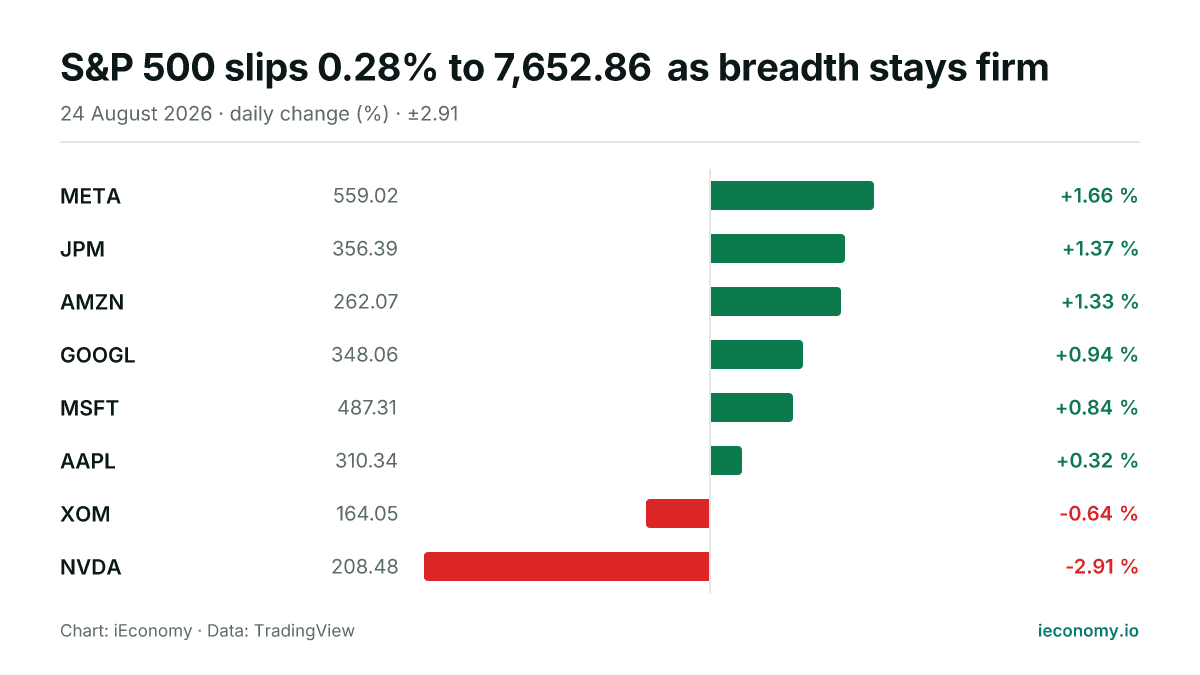
S&P 500 slips 0.28% to 7,652.86 as breadth stays firm
The S&P 500 edged lower on Monday, finishing at 7,652.86 after a modest decline of 0.28%. Among the eight tracked constituents, six rose and two fell, with META the strongest and NVDA the weakest.
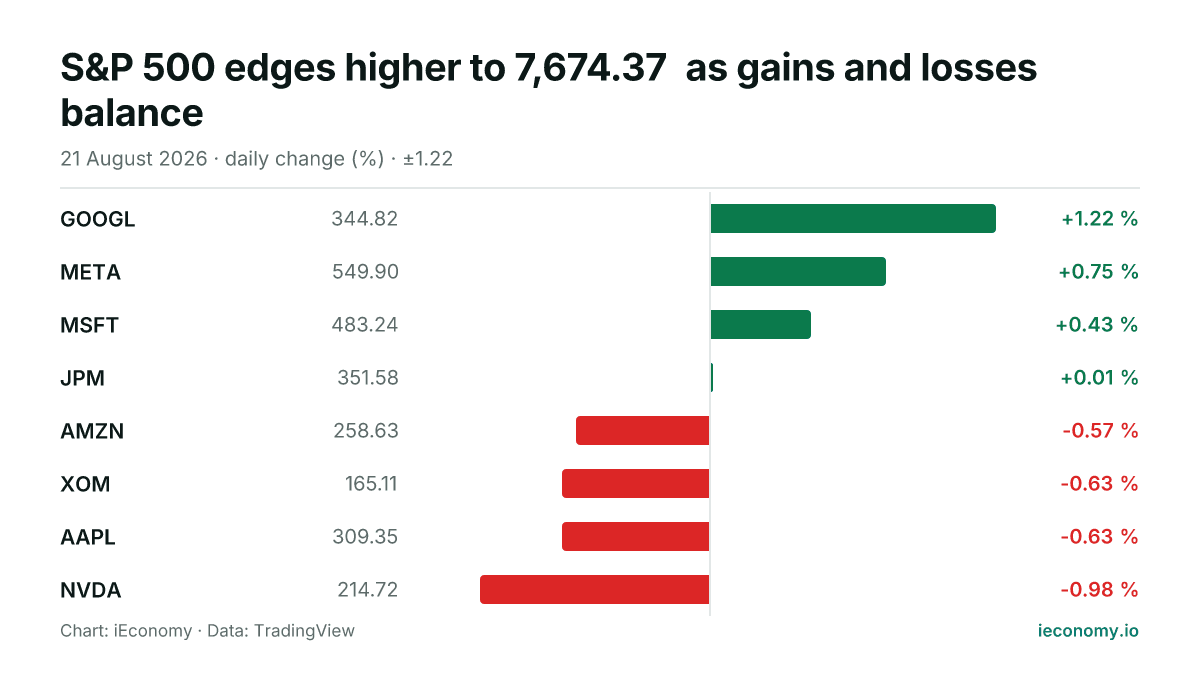
S&P 500 edges higher to 7,674.37 as gains and losses balance
The S&P 500 rose 0.43% to 7,674.37 on Friday. Among the eight tracked constituents, four finished higher and four lower, with GOOGL the strongest and NVDA the weakest.
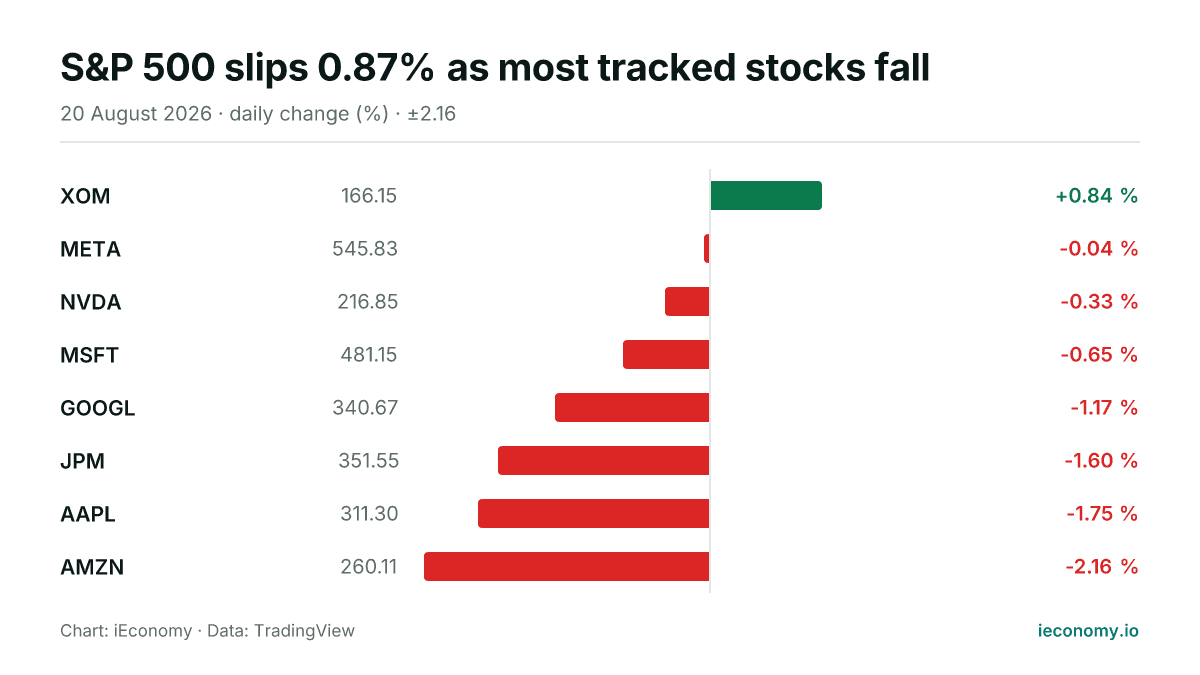
S&P 500 slips 0.87% as most tracked stocks fall
The S&P 500 ended Thursday at 7,641.16, down 0.87% on the session. Among the eight tracked constituents, one finished higher and seven were lower, with AMZN the weakest and XOM the strongest.
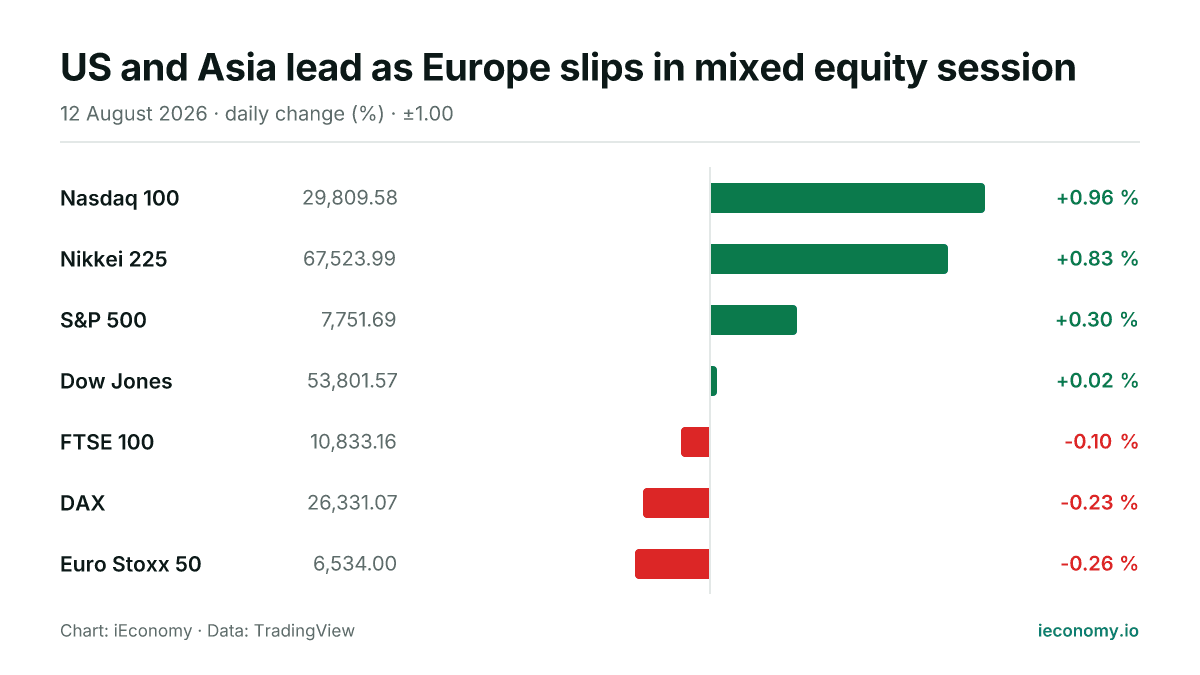
US and Asia lead as Europe slips in mixed equity session
Global shares were mixed on Wednesday, with Wall Street and Japan advancing while major European benchmarks edged lower. The day’s moves were modest in most cases, suggesting a market still trading index by index rather than in one broad direction.
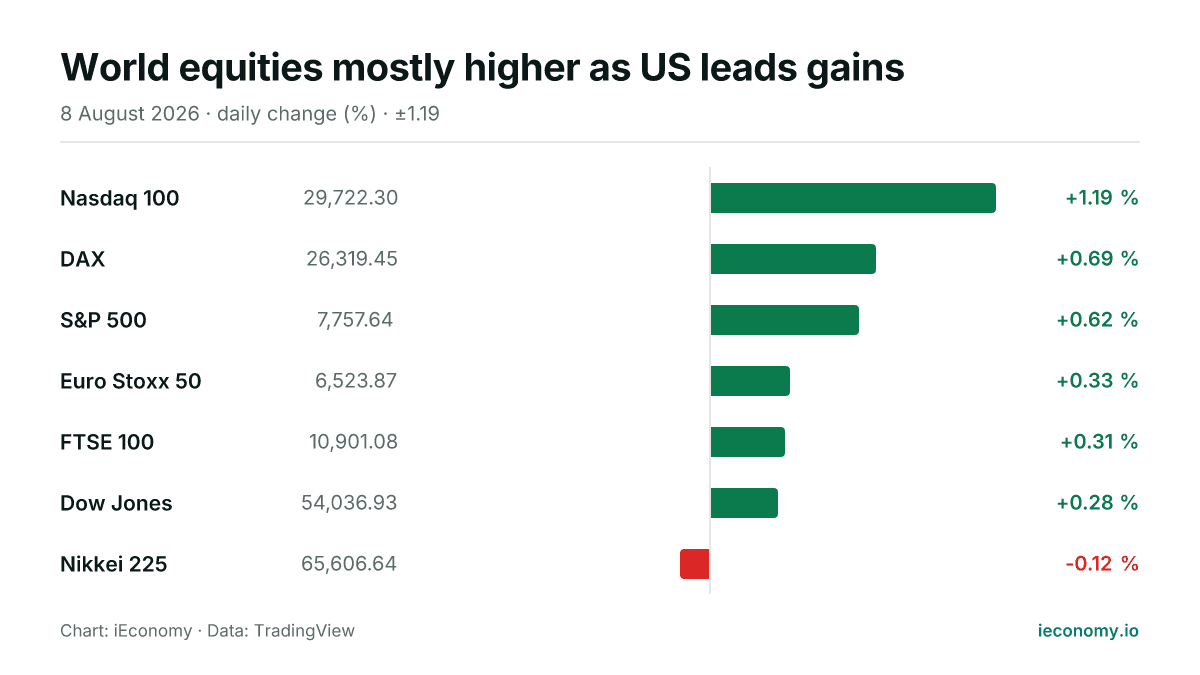
World equities mostly higher as US leads gains
Global stock markets were broadly firmer on Saturday, with six of seven tracked indices in positive territory. The Nasdaq 100 outperformed, while the Nikkei 225 was the only major gauge to edge lower.
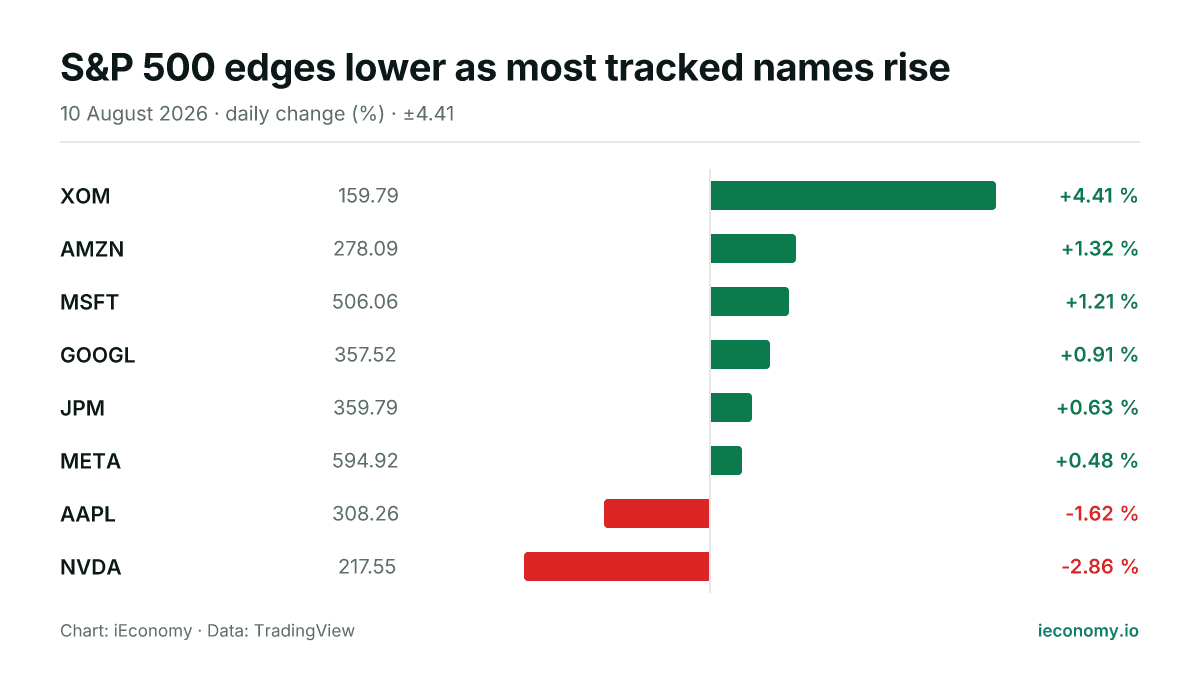
S&P 500 edges lower as most tracked names rise
The S&P 500 closed at 7,753.11 on Monday, down 0.06% as six of the eight tracked constituents finished higher. XOM was the strongest performer, while NVDA was the weakest.