Why Is Intuit Stock Falling? INTU Beat Earnings but Guidance Did the Damage
Intuit topped fourth-quarter revenue and profit forecasts, yet INTU shares slid. The reason is not the quarter — it is the fiscal 2027 outlook.
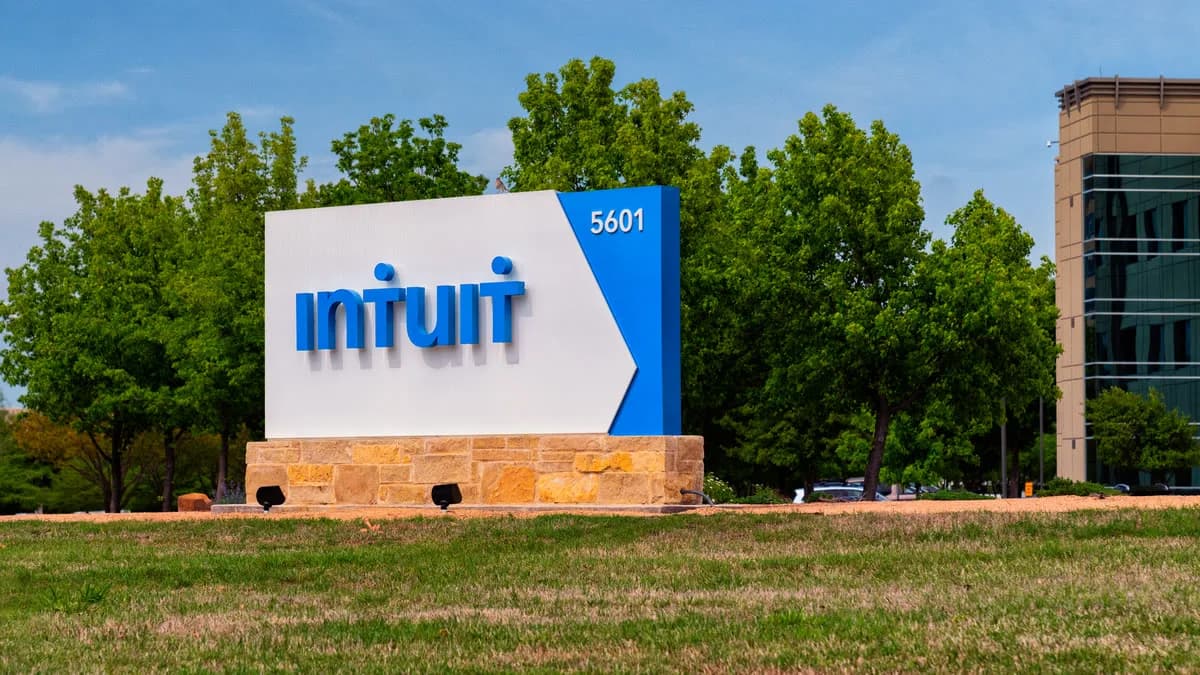
Tony Webster / Wikimedia Commons (CC BY 2.0)
Intuit (Nasdaq: INTU) reported fourth-quarter results after the close on 25 August and beat on both revenue and profit — and the stock fell anyway. Shares dropped 8.69% in after-hours trading and were down roughly 11.8% before the open. The trigger was not the quarter that ended; it was the guidance for fiscal 2027.
- Q4 revenue of $4.35 billion, up 14% year over year, against a $4.27 billion consensus.
- Adjusted earnings of $4.03 per share versus $3.59 expected.
- Fiscal 2027 revenue growth guided to 9–10%, down from 14% in fiscal 2026.
- Online paying customer growth slowed to 3% year over year.
Intuit cleared both headline numbers. Full-year revenue reached $21.45 billion, growing 14%. On its own, that result does not explain a double-digit drawdown in a fundamentally screened large-cap software name.
| Fourth quarter | Reported | Consensus |
|---|---|---|
| Revenue | $4.35B (+14%) | $4.27B |
| Adjusted EPS | $4.03 | $3.59 |
So why did the stock fall?
The break is in the outlook. Intuit guided fiscal 2027 revenue to $23.3–$23.5 billion, which works out to 9–10% growth — a clear step down from the 14% delivered in fiscal 2026. For a company trading on a growth multiple, a slower growth rate compresses the multiple before it touches a single dollar of profit.
Management also flagged weaker growth at Mailchimp, and online paying customer additions slowed to 3% year over year. Slower customer acquisition is the mechanism behind the revenue deceleration, not a separate problem.
The "huge EPS miss" is mostly an accounting change
The number driving headlines is this: Intuit guided fiscal 2027 adjusted EPS to $22.88–$23.12 against a $27.30 consensus. Reading that as a 16% miss is wrong, because the two figures do not measure the same thing.
Starting in the first quarter of fiscal 2027, Intuit no longer excludes share-based compensation from its adjusted measures. There is $5.81 per share of that expense embedded in the guidance. The consensus was built on the old definition, which excluded it.
| FY2027 adjusted EPS | Figure | Share-based comp |
|---|---|---|
| Company guidance (new basis) | $22.88–$23.12 | included |
| Analyst consensus (old basis) | $27.30 | excluded |
| Guidance + comp (like for like) | $28.69–$28.93 | comparable |
Put on the same basis, the guidance sits above consensus rather than below it. The same distortion explains most of the gap between the $2.44–$2.48 first-quarter guide and the $4.02 the street had modelled. The real story is the revenue deceleration, not a collapse in profitability.
What happens next
Three things to watch: whether customer growth recovers from 3%, whether Mailchimp returns to growth, and where the first reported quarter under the new definition lands within guidance. Year-over-year comparisons will need care for the next four quarters because the reporting basis changed mid-stream.
Frequently asked questions
Why is Intuit stock falling today?
Did Intuit beat earnings? Yes. Revenue of $4.35 billion beat the $4.27 billion consensus and adjusted EPS of $4.03 beat $3.59.
Did Intuit beat earnings?
Why does the EPS guidance look so far below consensus? The definition changed. Intuit now includes share-based compensation in adjusted earnings — $5.81 per share of it sits inside the guidance — while the consensus was built without it.
Why does the EPS guidance look so far below consensus?
What does Intuit do? It is a US software company that owns TurboTax, QuickBooks, Credit Karma and Mailchimp, serving small-business accounting and consumer tax filing.
What does Intuit do?
If you are following this: what actually moves a stock on earnings day and how stretched valuations react to slower growth both extend this picture.
Sources
Related News

Why Did Meta Stock Open High Then Fall? The Settlement Fixed the Wrong Problem
Meta agreed a $16.7 billion settlement with 29 states and opened 3.9% higher, then gave it all back. The reason is not legal risk — it is cash burn.

Nvidia, Salesforce, Broadcom lead dense US earnings slate
Fifteen large US companies report over the next 14 days, with Nvidia, Salesforce and Broadcom among the most closely watched names.
Nvidia, Walmart and Home Depot headline 15 US earnings reports
Fifteen large US companies report over the next 14 days, led by Nvidia, Walmart, Home Depot and a cluster of retail and tech names.

S&P 500 and Nasdaq Notch Fresh Records on Strong Tech Earnings
Better-than-expected quarterly results from major technology firms lifted broad indices to new all-time closing highs.

Microsoft and Alphabet Cloud Units Post Revenue Beats
Both companies reported cloud-computing growth that exceeded analyst estimates, lifting shares in after-hours trading.
Disney parks post record revenue despite U.S. travel slump
Disney’s experiences unit delivered a record quarter as theme parks and related businesses offset weaker international travel to the United States, lifting operating income and shares.