Why Did Meta Stock Open High Then Fall? The Settlement Fixed the Wrong Problem
Meta agreed a $16.7 billion settlement with 29 states and opened 3.9% higher, then gave it all back. The reason is not legal risk — it is cash burn.

LPS.1 / Wikimedia Commons (CC0)
Meta Platforms (Nasdaq: META) traded 3.9% higher before the open and then turned negative during the session. As of 09:45 EDT the stock was at $566.19, down 0.68% on the day — the entire pre-market gain erased. Two moves, two separate causes, and they should not be conflated.
- Meta reached a settlement of roughly $16.7 billion with 29 US states over claims its platforms were designed to be addictive to minors.
- Meta's own legal team had modelled a worst-case exposure as high as $1.4 trillion.
- The stock still could not hold the gain: second-quarter free cash flow fell 91% year over year to $784 million.
- The 52-week range is $520.26–$790.80; the stock sits 8.8% above the low and 28.4% below the high.
The settlement put a ceiling on something. The trial that opened in Oakland on 18 August had kept a $1.4 trillion tail risk on the table, and that uncertainty was pressing directly on the valuation. The headline number is large, but its real value is converting an unknown into a known.
So why did the gain not hold?
Because the settlement does not touch the line that actually prices this stock. That line showed up in the 29 July results: Meta is spending nearly every dollar its business generates on AI infrastructure.
| Second quarter | Figure | Note |
|---|---|---|
| Free cash flow | $784M | −91% year over year |
| Capital expenditure | $31.1B | close to double |
| Operating cash flow | $31.9B | almost all of it spent |
| Earnings per share | $6.18 | vs $7.14 expected · −14% |
That EPS miss includes $2.4 billion in legal charges and $1.2 billion in severance. Most analysts expect free cash flow to turn negative by year-end and stay negative through 2027. The stock is down 11.5% over 30 days.
Today's intraday reversal is therefore not a contradiction but a separation: the market priced out the legal tail risk and left the capital-intensity problem exactly where it was. Two different problems, and one does not solve the other.
Is it a buying opportunity? What the question reduces to
This is not investment advice, but the question can be stated precisely: will this capital spending convert into revenue? Both sides rest on measurable numbers.
| Valuation metric | Value |
|---|---|
| Price / earnings | 21.48 |
| Forward price / earnings | 17.80 |
| Market capitalisation | $1.44T |
| Analyst target (62 analysts) | $754.84 · +33% |
The cheap case: a forward multiple of 17.80 is historically low for Meta. The advertising business still funds everything, and the legal tail risk was capped today.
The re-rating case: the market is moving Meta from "cash machine" to "capital-intensive infrastructure builder". If that is a change of multiple regime rather than a dip, a low multiple is not cheapness — it is the new normal. With free cash flow down 91%, a cash-flow-based valuation argument does not function anyway.
What happens next
The measurable break point is the third quarter: whether capex guidance stabilises and whether advertising revenue growth covers that spending. Today's reaction does not answer that; it only says the legal uncertainty has been priced out.
Frequently asked questions
Why is Meta stock falling today?
How large is the Meta settlement? Roughly $16.7 billion with 29 states. Meta's own legal team had modelled a worst case as high as $1.4 trillion, so the settlement caps that tail risk.
How large is the Meta settlement?
Is Meta stock cheap? A forward multiple of 17.80 looks low historically. But in a company whose free cash flow has collapsed, a low multiple can signal a changed valuation regime rather than a bargain. Both readings use the same data.
Is Meta stock cheap?
What do analysts expect? 62 analysts carry an average target of $754.84, roughly 33% above the current level.
What do analysts expect?
If you are following this: what actually moves a stock on earnings day and how stretched valuations react to slower growth extend this picture.
Sources
Related News
Why Is Intuit Stock Falling? INTU Beat Earnings but Guidance Did the Damage
Intuit topped fourth-quarter revenue and profit forecasts, yet INTU shares slid. The reason is not the quarter — it is the fiscal 2027 outlook.

Meta settles child safety trial for $12.6 billion
The social media giant agreed to pay billions and implement teen usage limits and nighttime blocks to settle federal allegations it misrepresented mental health harms.
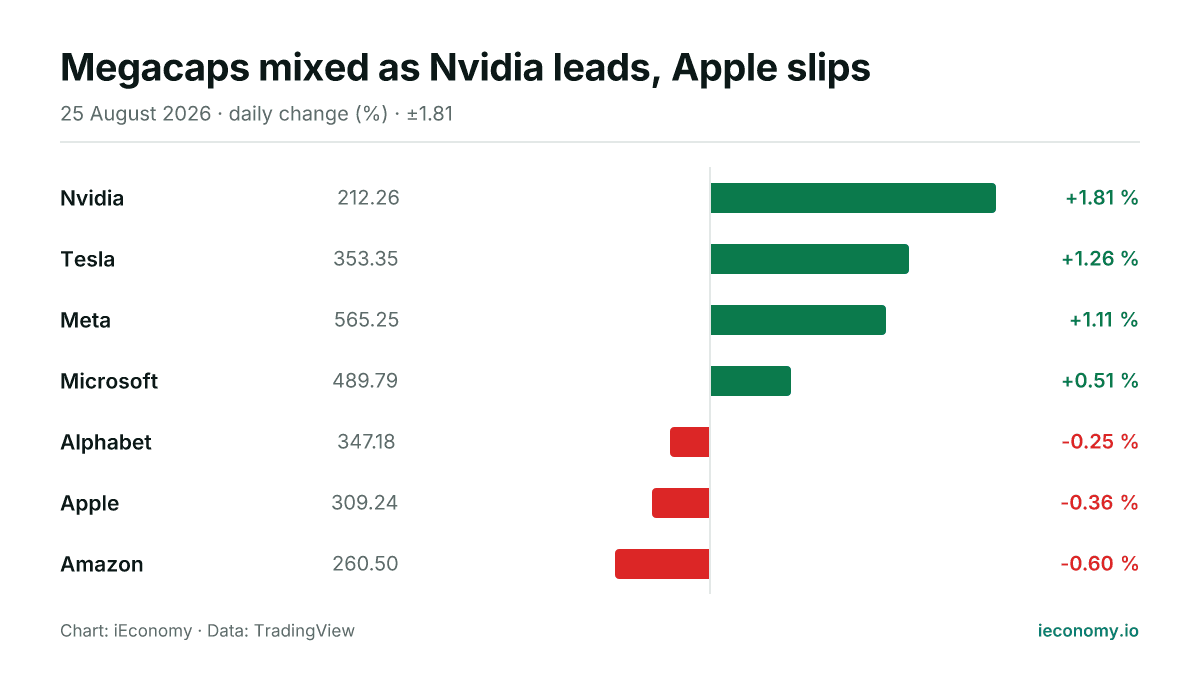
Megacaps mixed as Nvidia leads, Apple slips
Nvidia, Tesla and Meta led a broadly firmer megacap group on Tuesday, while Apple, Alphabet and Amazon finished lower. The moves were modest enough to matter for relative performance more than for the index itself.
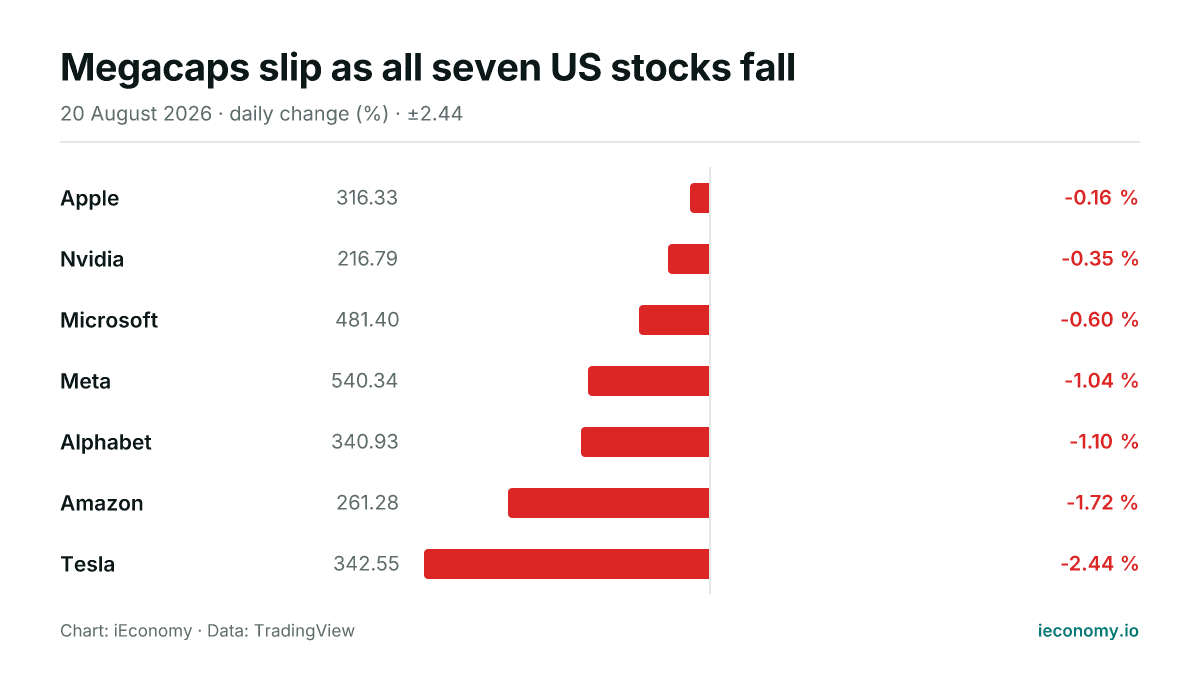
Megacaps slip as all seven US stocks fall
Apple, Nvidia, Microsoft and their megacap peers were all lower on Thursday, with Tesla and Amazon lagging. The move was broad rather than selective, leaving no name in positive territory.

Earnings calendar: megacaps, chipmakers and healthcare names
Fifteen large US companies are due to report from Aug 3 to Aug 13, led by Berkshire Hathaway, Eli Lilly, AMD and Disney.
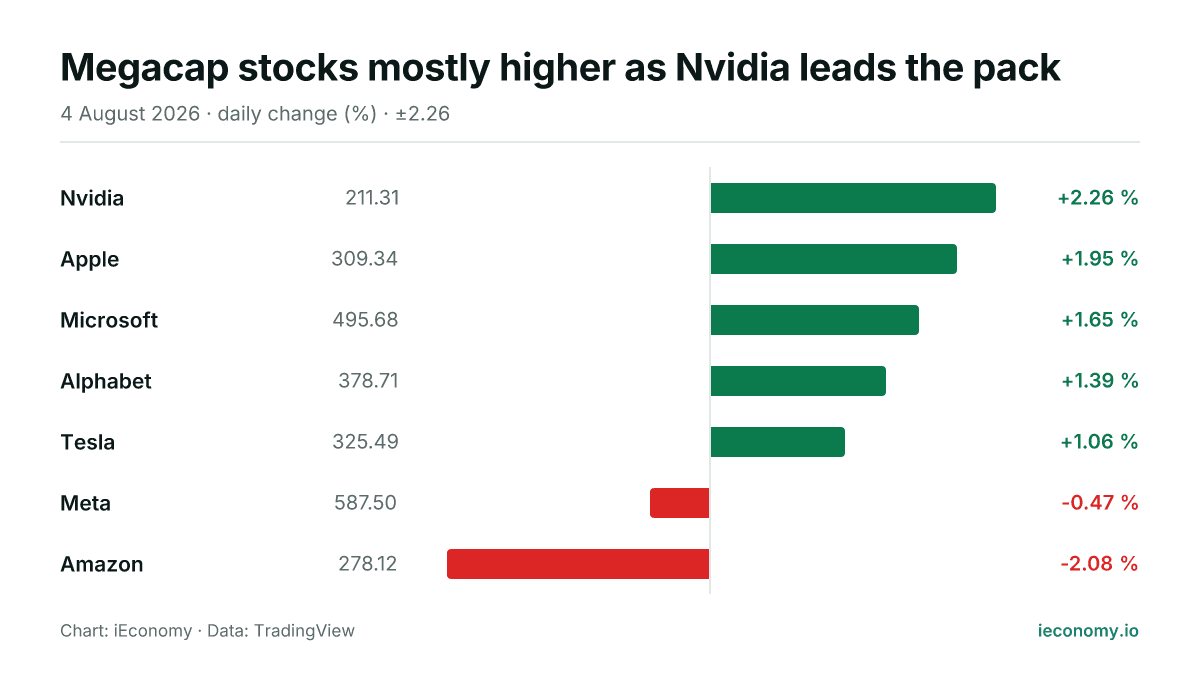
Megacap stocks mostly higher as Nvidia leads the pack
Five of the seven leading US megacaps were higher on Tuesday, with Nvidia, Apple and Microsoft all advancing. Meta and Amazon lagged, leaving the group with a mixed but broadly firmer tone.