Nvidia Analysis: Consolidation Phase Amid AI Infrastructure Buildout
Nvidia trades at $209.84, showing modest daily gains but consolidating after a strong start to 2026. With an RSI of 53.9 indicating neutral momentum, the focus shifts to execution within its core AI and data center franchises against a backdrop of elevated investor expectations.
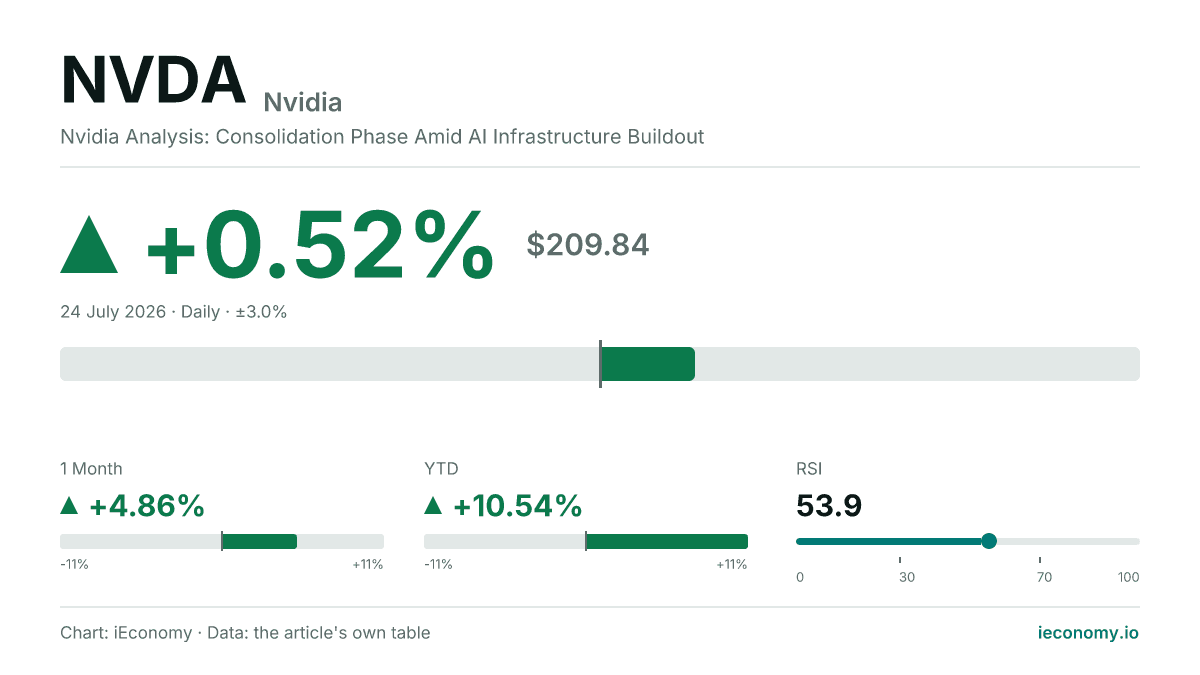
Chart: iEconomy · Data: the article's own table
Nvidia's stock price of $209.84 reflects a period of consolidation, with a modest daily gain of +0.52% and a year-to-date advance of +10.54%. The neutral 53.9 RSI reading suggests a lack of immediate overbought or oversold pressure, placing the equity in a technical equilibrium.
The primary investment thesis centers on the company's ability to translate its dominant position in accelerated computing for artificial intelligence into sustained financial performance, even as it navigates cyclical demand patterns, intense competition, and the execution of its expanded software and services roadmap.
The current price action indicates a market weighing near-term execution against long-term structural growth narratives.
| Indicator | Value |
|---|---|
| Last price (USD) | 209.84 |
| Daily | +0.52% |
| 1 Month | +4.86% |
| YTD | +10.54% |
| RSI (14) | 53.9 |
Macro and Sector Drivers
The broader environment for semiconductor and AI infrastructure capital expenditure remains a critical driver. Corporate and cloud investment cycles, rather than consumer electronics, are now the predominant demand lever for Nvidia's high-performance data center products.
Geopolitical factors influencing trade and technology transfer, particularly concerning advanced chip exports, continue to introduce a layer of regulatory uncertainty.
Furthermore, the sector is characterized by rapid innovation cycles; the market is closely monitoring the adoption curve for Nvidia's latest architecture platforms and the competitive response from peers developing alternative AI accelerators.
The stock's +4.86% one-month performance suggests cautious optimism, but it is tempered by the need for tangible evidence of the next major wave of enterprise AI deployment.
Technical Picture and Market Positioning
Technically, the provided metrics paint a picture of a stock in a holding pattern. The 14-day RSI of 53.9 sits squarely in neutral territory, indicating balanced buying and selling pressure over the recent period and suggesting the prior momentum has stalled.
This aligns with the performance data: a solid but not explosive year-to-date return of +10.54%, coupled with a more moderate +4.86% gain over the past month. This consolidation phase often follows a period of significant advancement, allowing the stock to digest gains.
From a market positioning perspective, this neutral RSI can be interpreted as a pause that refreshes, providing a base from which the next directional move could emerge, dependent on forthcoming catalysts related to financial results or product announcements.
Fundamental and Structural View
Fundamentally, Nvidia's story has evolved from a cyclical graphics company to a foundational provider of AI infrastructure. Its structural advantage lies in the full-stack integration of its hardware (GPUs), networking (InfiniBand), and increasingly its enterprise AI software platforms.
This creates significant ecosystem lock-in and high switching costs for customers building large-scale AI training and inference clusters.
The key question is the sustainability of its gross margins at elevated levels, which are underpinned by this platform approach but face pressure from competition, internal cost structures for next-generation nodes, and potential changes in customer buying patterns.
The company's strategic pivot into recurring software and services revenue is critical for diversifying its income streams and smoothing out the volatility inherent in hardware upgrade cycles.
Conditional Forward Scenarios
Conditional scenarios for Nvidia's trajectory are heavily tied to execution and market dynamics. In a bullish scenario, stronger-than-anticipated demand for its next-generation data center products, coupled with successful monetization of its AI enterprise software, could reignite momentum.
This would likely be accompanied by RSI readings moving decisively above 60, breaking the current consolidation.
In a base-case scenario, the company meets high but managed expectations, delivering steady quarterly execution that supports a gradual upward trend in line with broader market growth, with the RSI oscillating in its current neutral range.
A bearish scenario would involve a significant slowdown in AI infrastructure spending, market share erosion to competitive or in-house silicon solutions, or a macroeconomic downturn impacting tech capex. This could pressure valuations and potentially drive the RSI toward or below oversold thresholds, testing lower price supports.
Risk Factors and Monitoring Points
Principal risks are multifaceted. Competitive intensity is rising, with major cloud providers and semiconductor rivals investing heavily in alternative AI chips. Cyclicality in data center spending poses an inventory and demand risk, especially after a period of intense investment.
Geopolitical and trade policy remains a persistent overhang, capable of instantly altering addressable market size. Execution risk in its software transition is also nontrivial, as it involves different sales motions and success metrics.
Key monitoring points for investors include quarterly data center revenue growth rates and guidance, gross margin trends, commentary on the adoption of new product architectures, updates on the competitive landscape, and any material changes in the regulatory environment for exports.
The evolution of the RSI from its current neutral level will also provide a technical signal of shifting market sentiment alongside these fundamental developments.
Sources
Related News
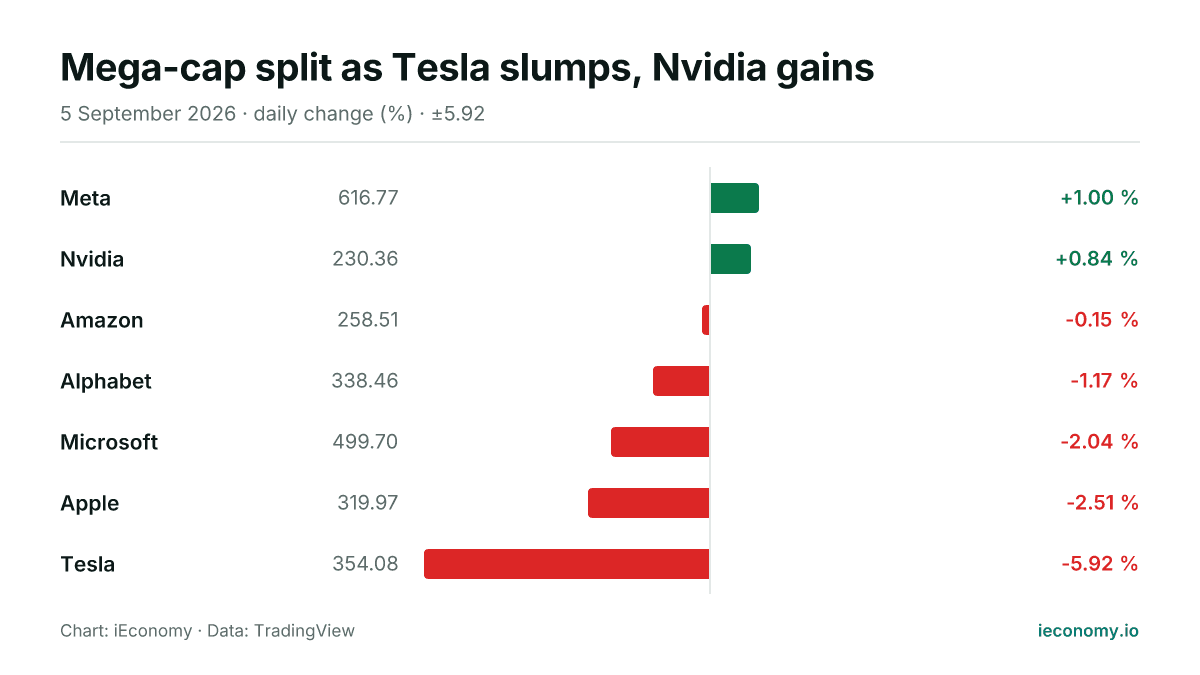
Mega-cap split as Tesla slumps, Nvidia gains
US megacaps finished the day mixed on Saturday, with Nvidia and Meta higher while Apple, Microsoft, Alphabet and Tesla fell. The spread shows how even the largest names can diverge sharply in one session.
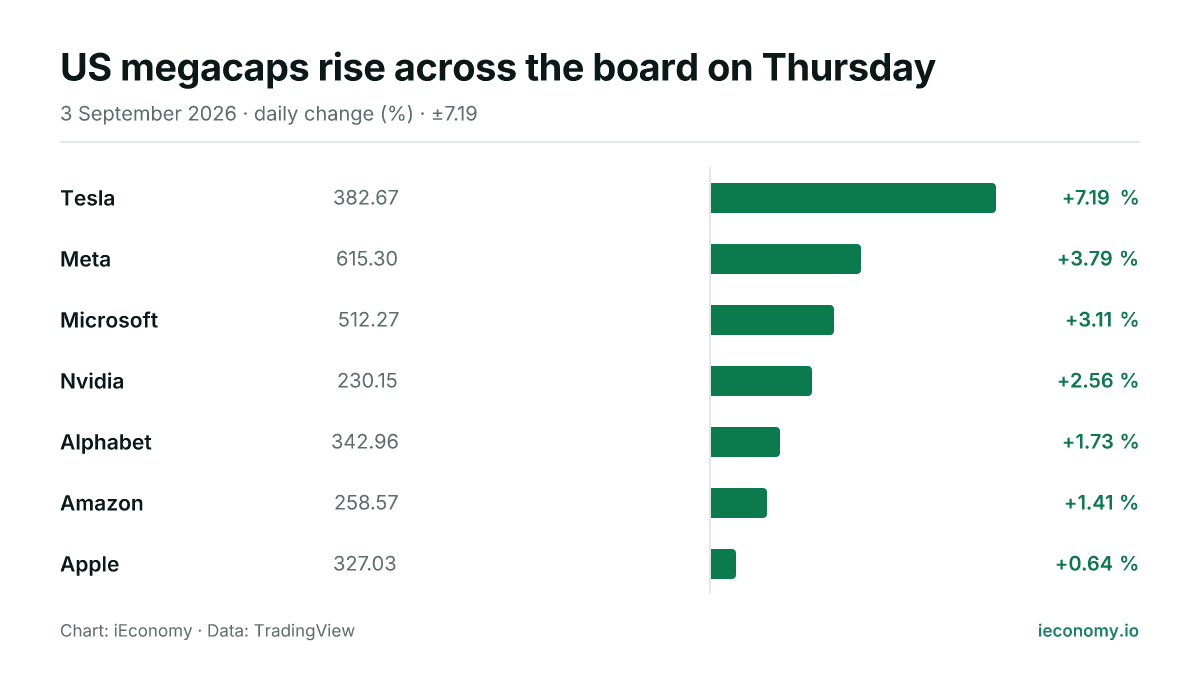
US megacaps rise across the board on Thursday
Apple, Microsoft, Nvidia and the other megacaps finished higher on Thursday, with all seven tracked stocks advancing. Tesla led gains, while Apple lagged but still rose, underscoring broad leadership rather than a narrow move.
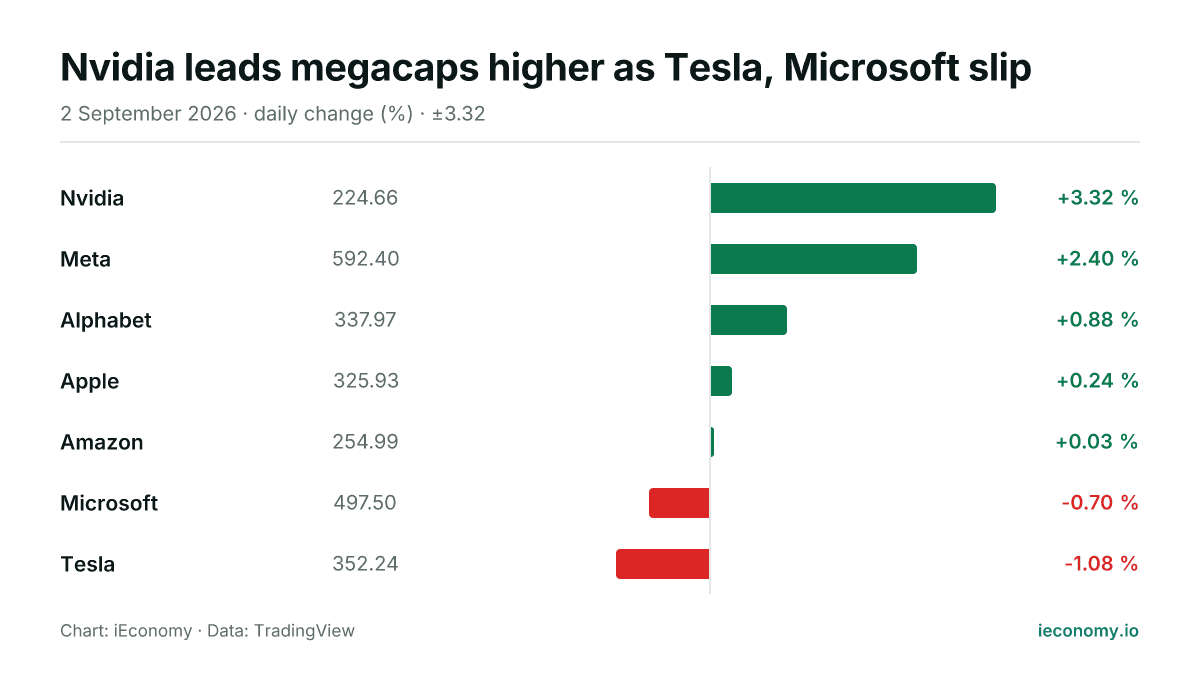
Nvidia leads megacaps higher as Tesla, Microsoft slip
US megacaps were mostly firmer on Wednesday, with Nvidia out front and Meta also gaining. Microsoft and Tesla lagged, while Apple and Amazon were little changed, leaving the group mixed but broadly constructive.

China exports beat forecasts as AI shipments jump
China’s July exports rose faster than expected, led by demand for high-tech goods and AI-related components, even as the pace cooled from June’s surge.
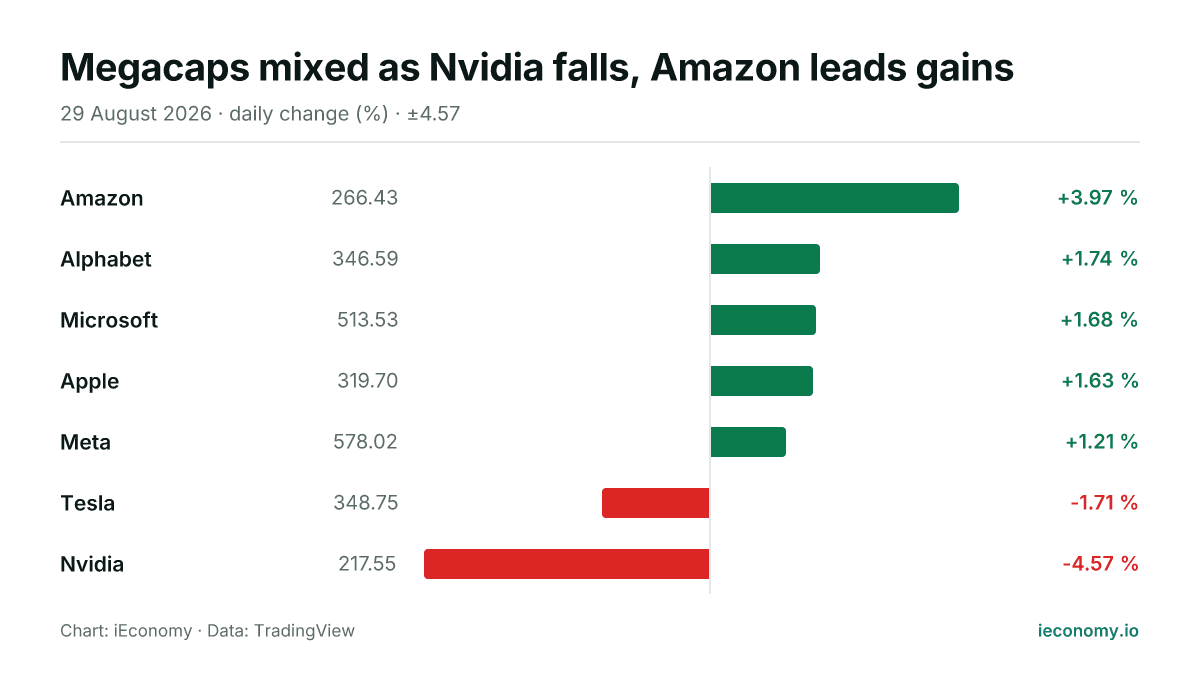
Megacaps mixed as Nvidia falls, Amazon leads gains
Five of seven megacaps rose on Saturday, but the group’s move was uneven: Amazon led advances while Nvidia and Tesla slipped. The day was a reminder that index-heavy stocks can diverge sharply even within the same cohort.

Intel upsizes stock offering to $20 billion
Intel lifted its planned share sale to $20 billion at $95 a share, saying the funds will support general corporate needs as AI-related demand keeps building.