TSMC revenue hits record high on AI chip demand
Taiwan Semiconductor Manufacturing Co. reported a 53.3% year-on-year surge in August revenue to NT$514.8 billion, driven by sustained demand for AI server processors.

Rob Bulmahn / Wikimedia Commons (CC BY 2.0)
Taiwan Semiconductor Manufacturing Co. (TSMC) posted record monthly revenue for August, underscoring the relentless demand for advanced semiconductors powering artificial intelligence applications. The world's largest contract chipmaker reported revenue of NT$514.8 billion ($16.35 billion) last month, a staggering 53.3% increase from August of the previous year. The figure also represents a sequential growth of 10.1% from July, indicating sustained momentum.
Foundry dominance and market share
The surge solidifies TSMC's commanding position in the global semiconductor foundry market. According to data from research firm TrendForce, TSMC held a 72.5% market share in the second quarter of this year. This dominance is directly linked to its control over the most advanced manufacturing processes. TrendForce noted that strong demand for AI server processors kept TSMC's cutting-edge 5-, 4-, and 3-nanometer production capacity fully booked throughout the quarter.
The broader foundry market is also experiencing a boom, fueled by the same technological trends. The world's top ten foundries collectively achieved a record $53.49 billion in revenue during the second quarter. This growth is partly attributed to supply constraints for the advanced processes required to manufacture AI and high-performance computing chips, where TSMC is the primary supplier. Samsung Foundry ranked a distant second with a 5.9% share, followed by China's SMIC at 5.4%.
Strategic outlook and future technology
TSMC's financial performance follows a blockbuster second quarter, where it reported a more than 77% year-on-year jump in net profit. The company has maintained an optimistic outlook, forecasting third-quarter revenue between $44.6 billion and $45.8 billion. During its July earnings call, TSMC described AI-related demand as continuing to be "extremely robust," a sentiment clearly reflected in its latest monthly figures.
Looking beyond current production, TSMC is already laying the groundwork for the next generation of chipmaking. This week, the company announced a joint initiative with Dutch lithography giant ASML to advance the industry's transition to next-generation technology. TSMC plans to implement ASML's High NA extreme ultraviolet (EUV) lithography technology in large-scale manufacturing for its most advanced nodes starting in 2030.
The move is a strategic bet on the future needs of AI. As AI models grow more complex, they require increasingly sophisticated transistor architectures, which in turn depend on more advanced manufacturing tools. The adoption of High NA technology is expected to accelerate as these computational demands push the limits of current chipmaking capabilities, ensuring TSMC remains at the forefront of production for years to come.
The record revenue highlights a market where demand for AI-capable silicon continues to outstrip supply, funneling immense revenue toward the few companies capable of producing it. For investors and the tech industry, TSMC's monthly results serve as a critical barometer for the health and direction of the global AI hardware ecosystem.
This article is not investment advice and recommends no asset, level or direction; a single session's move is not evidence of a trend. For background see Stocks, Bear Market, BIST 100, and for terms the finance glossary.
Frequently asked questions
What was TSMC's revenue for August 2026?
TSMC reported August revenue of NT$514.8 billion (New Taiwan dollars), which is approximately $16.35 billion.
How does TSMC's market share compare to its competitors?
According to TrendForce data, TSMC held a 72.5% share of the global foundry market in the second quarter of 2026. Samsung Foundry was second with 5.9%, and China's SMIC was third with 5.4%.
What technology is TSMC planning for future chip production?
TSMC has announced plans with ASML to use High NA extreme ultraviolet lithography technology in large-scale manufacturing for its most advanced nodes, with adoption starting in 2030 to meet the demands of future AI applications.
Sources
Related News

Eyes on Tech Titans as Broadcom, Palo Alto Networks Report
A busy fortnight of US earnings begins with major technology and infrastructure firms, led by chip giant Broadcom and cybersecurity leader Palo Alto Networks.
AI infrastructure stocks climb on Qualcomm and Corning deals
Corning and Qualcomm rose on new partnership announcements, lifting AI infrastructure shares including Intel, AMD, HPE and Coherent as investors bet on sustained data center spending.
Eight large US groups due to report over the next 14 days
Oracle, Adobe and Kroger are among eight large US companies scheduled to report between Sep 8 and Sep 17, with earnings releases clustered around mid-September.

Most large US reporters topped consensus last week
Fourteen of 15 large US companies reported EPS above consensus in the past seven days, with results spanning energy, healthcare, software and industrials.
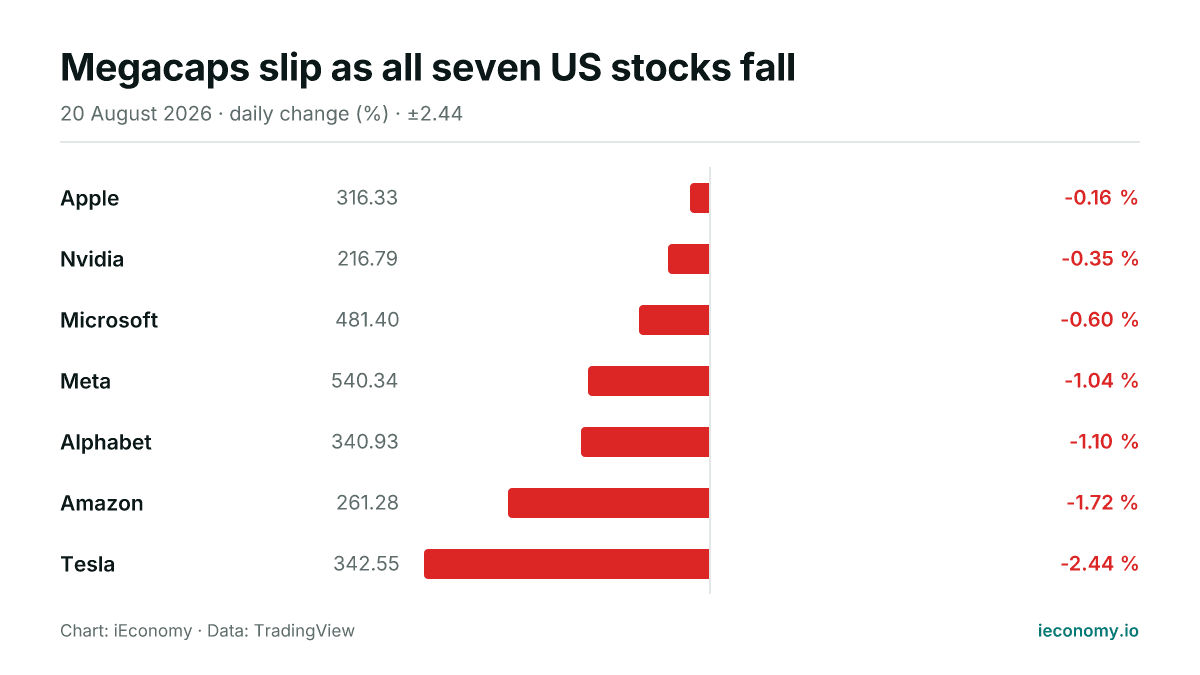
Megacaps slip as all seven US stocks fall
Apple, Nvidia, Microsoft and their megacap peers were all lower on Thursday, with Tesla and Amazon lagging. The move was broad rather than selective, leaving no name in positive territory.
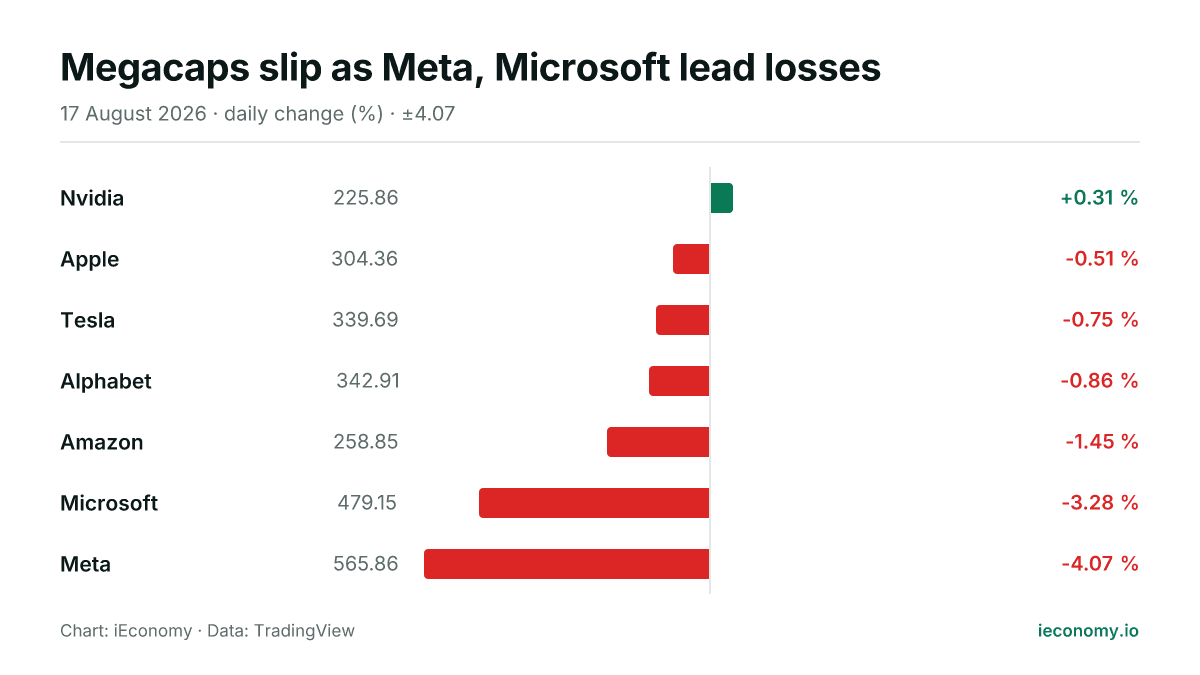
Megacaps slip as Meta, Microsoft lead losses
Wall Street’s biggest technology stocks were mostly lower on Monday, with only Nvidia in positive territory. Meta and Microsoft posted the sharpest declines, while Apple, Amazon, Alphabet and Tesla also fell.