Nvidia Shares Fall 4.57% in Single-Session Pullback
The chipmaker's stock closed at $217.55, a significant single-day decline. We examine the general market mechanics that can drive such moves and what they…

Coolcaesar / Wikimedia Commons (cc-by-sa-3.0)
Nvidia shares closed trading at $217.55, marking a daily decline of 4.57%. This single-session move represents a notable pullback for the U.S. mega-cap stock, which has been a focal point for investors focused on artificial intelligence and semiconductor technology.
A price movement of this magnitude in a large, liquid stock like Nvidia typically reflects a shift in the near-term balance between buying and selling pressure. It is crucial to frame such a move within the context of broader market behavior and the specific characteristics of high-growth, momentum-driven sectors.
General Mechanics Behind Mega-Cap Moves
Significant single-day moves in major technology stocks often stem from a confluence of factors rather than a single catalyst. For a company like Nvidia, which trades at a premium valuation based on future growth expectations, price can be sensitive to shifts in market-wide sentiment toward risk. A broad sell-off in the technology sector or a rise in Treasury yields, which affects the discounted value of future earnings, can precipitate widespread selling in growth-oriented names.
Furthermore, these stocks are heavily influenced by institutional capital flows. Large block trades, portfolio rebalancing by major funds, or profit-taking after a sustained rally can create outsized volume and price movement in a single session. The stock's high liquidity means these flows are absorbed efficiently, but they can still move the price meaningfully within a day.
What This Move Does and Does Not Signal
A 4.57% decline is a substantial single-day event, but it is not, by itself, a trend. It represents a data point in the ongoing auction process of the market. For long-term readers, it serves as a reminder of the inherent volatility present even in the largest companies, especially those in cyclical and sentiment-driven industries like semiconductors.
Historically, such moves do not necessarily indicate a reversal of a long-term thesis. They can represent healthy consolidation after a strong run, a reaction to macroeconomic data, or simple volatility around major events like earnings reports, even if no company-specific news is announced. It underscores the difference between short-term trading dynamics and long-term investment fundamentals, which are driven by sustained execution, market share, and financial performance over quarters and years.
This article is not investment advice and recommends no asset, level or direction; a single session's move is not evidence of a trend. For background see Stocks, Bear Market, BIST 100, and for terms the finance glossary.
Frequently asked questions
Does a 4.57% drop mean the trend for Nvidia has changed?
No, a single session's price movement does not define a trend. Trends are established over weeks and months through a series of higher highs and higher lows (for an uptrend) or lower highs and lower lows (for a downtrend). One day of selling, while significant, is insufficient data to conclude a change in the longer-term directional bias of the stock.
What typically causes big down days in stocks like Nvidia?
Large single-day declines in major growth stocks can often be attributed to sector-wide rotation, where money moves out of one area of the market (e.g., technology) and into another (e.g., defensive sectors). They can also be driven by profit-taking from large investors, reactions to moves in the broader bond market which affect valuation models, or anticipation of or reaction to industry-specific news, even if none is directly tied to the company on that day.
How should long-term investors interpret this kind of volatility?
For long-term investors, short-term volatility is a normal characteristic of equity markets, particularly for stocks in innovative and rapidly evolving sectors. A disciplined investment process typically focuses on the underlying business fundamentals—such as product cycles, competitive positioning, and financial health—rather than daily price fluctuations. A single-day move, while noteworthy, rarely alters those core long-term drivers.
Sources
Related News
Nvidia customers face higher AI server prices
Nvidia has warned some large customers that servers with its AI chips may cost more next year, with Bloomberg reporting increases of more than 15% in many cases.

Canadian mining stocks rally as resources data shifts
Canadian mining shares had a strong week as Canada’s second-quarter GDP rebounded and June output kept growing, even as oil sands and support services weakened.

Meta settlement puts TikTok and YouTube under pressure
Meta has settled a California trial over youth harms claims for up to $18 billion, with part of the payout contingent on rivals making similar product changes.

AI hedge fund Situational Awareness tumbles after stock selloff
Leopold Aschenbrenner’s AI-focused fund was forced to dump leveraged bets after a sharp semiconductor selloff, cutting assets from a peak of $45 billion to about $10 billion.
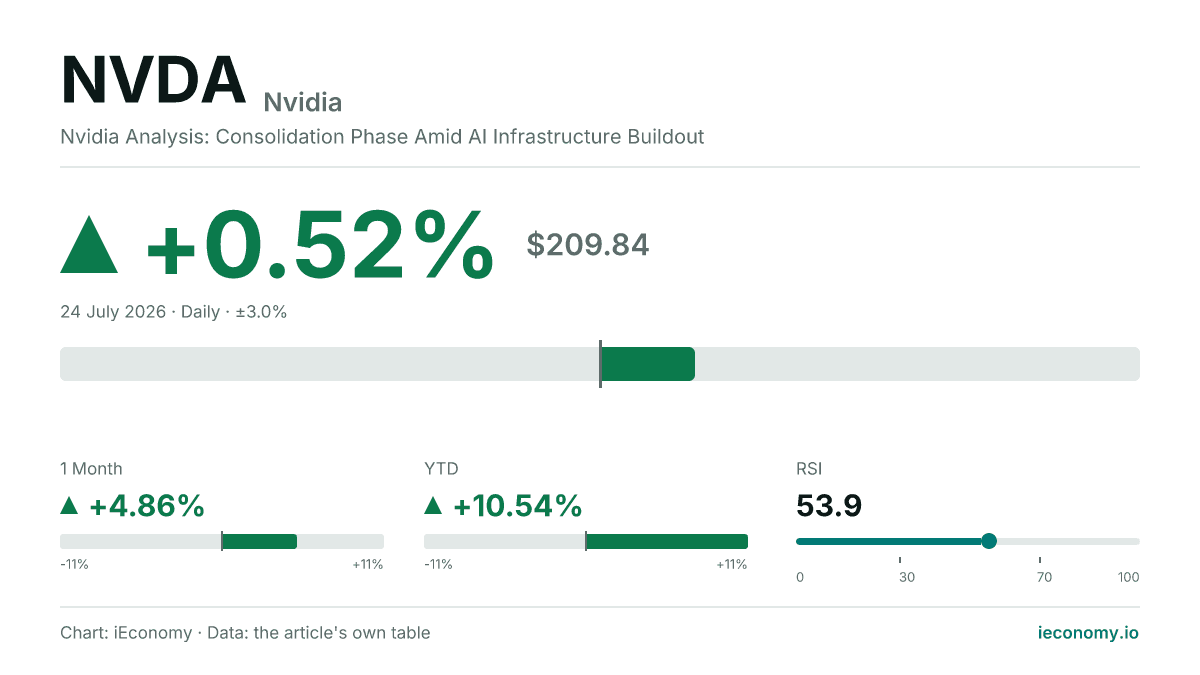
Nvidia Analysis: Consolidation Phase Amid AI Infrastructure Buildout
Nvidia trades at $209.84, showing modest daily gains but consolidating after a strong start to 2026. With an RSI of 53.9 indicating neutral momentum, the focus shifts to execution within its core AI and data center franchises against a backdrop of elevated investor expectations.

China exports beat forecasts as AI shipments jump
China’s July exports rose faster than expected, led by demand for high-tech goods and AI-related components, even as the pace cooled from June’s surge.