Copper Prices Fall Sharply Amid Industrial Metals Sell-Off
Copper futures dropped nearly 5% in a single session, reflecting a significant retreat in industrial commodity markets and highlighting the metal's…

Copper prices experienced a pronounced decline, with futures falling by nearly 5% to a last price of $6.5475. Such a single-day move represents a significant shift in sentiment for the industrial metal, which is often viewed as a barometer for global economic health. The scale of the drop warrants an examination of the typical market mechanics at play when copper, a key cyclical commodity, sees such volatility.
It is critical to contextualize this move. A sharp one-session decline, while notable, does not in itself constitute a reversal of a longer-term trend. It is, however, a clear signal of shifting short-term trader positioning and risk assessment within the industrial metals complex. The move prompts a look at the general factors that commonly drive copper's price action, from inventory flows to broader financial conditions.
Common Drivers Behind Copper's Volatility
Copper's price is notoriously sensitive to shifts in macroeconomic outlook. As a key input in construction and manufacturing, its demand prospects are tightly linked to expectations for global industrial growth. A sudden price decline of this magnitude often coincides with a rapid reassessment of that growth outlook. This can be triggered by data suggesting economic softening, shifts in central bank policy that tighten financial conditions, or a broad-based move away from risk assets in financial markets.
Furthermore, copper markets are influenced by physical inventory levels at major exchanges like the LME and Shanghai Futures Exchange. While daily price moves are primarily driven by paper futures trading, the backdrop of visible inventories can amplify sentiment. If rising stockpiles coincide with concerns over demand, it can accelerate selling pressure. The metal's status as a financially traded commodity also means it is susceptible to dollar strength; a rallying U.S. dollar can make copper more expensive for holders of other currencies, potentially dampening demand.
What the Move Does and Does Not Signal
A near-5% daily drop is a strong signal of immediate market sentiment. It indicates that a critical mass of traders and algorithmic strategies are repositioning based on a prevailing narrative, which could be related to economic data, geopolitical developments, or simply profit-taking after a prior rally. For market participants, it underscores the high-beta nature of copper, which can experience outsized moves relative to broader equity or bond markets.
However, it does not, by itself, forecast a sustained bear market. Single-session extremes are often followed by consolidation or even partial retracements as the market digests the new price level. A one-day move lacks the confirmation needed to establish a durable trend. Long-term copper direction is forged over weeks and months, driven by fundamental factors like the pace of the global energy transition (which is highly copper-intensive), sustained changes in Chinese industrial demand, and longer-term mine supply projections.
This article is not investment advice and recommends no asset, level or direction; a single session's move is not evidence of a trend. For background see Markets, Bear Market, BIST 100, and for terms the finance glossary.
Frequently asked questions
Does a 5% drop mean copper is now in a bear market?
No. A bear market is typically defined by a sustained and significant downward trend over an extended period, often 20% or more from a recent high. A single session's sharp decline, while significant, is not sufficient to establish that condition. It represents a severe short-term correction or reaction, but the longer-term trend requires confirmation from subsequent price action and fundamental data.
What macroeconomic indicators most directly affect copper prices?
Copper prices are most directly influenced by indicators of global industrial activity, particularly from major manufacturing economies like China, the United States, and Europe. Purchasing Managers' Index (PMI) data, industrial production figures, and construction spending reports are closely watched. Additionally, market expectations for central bank interest rate decisions can drive moves by altering the cost of carrying inventory and the investment appeal of non-yielding commodities.
How do traders typically react to such a large one-day move?
Professional traders often assess such a move by examining trading volume, changes in open interest (which indicates new money entering or leaving the market), and the price action relative to key technical levels established over prior weeks. A high-volume decline suggests conviction, while a drop on low volume might be viewed as less significant. The immediate reaction often involves managing risk by adjusting positions, while the subsequent sessions are watched for whether the selling pressure continues or stalls.
Sources
Related News

Gold lags as silver, oil and platinum surge
Commodities were broadly higher on Wednesday, with all six tracked instruments in positive territory. Platinum, Brent and silver led gains, while gold advanced more modestly and crude oil also moved sharply higher.
Gold slips as oil and silver edge higher
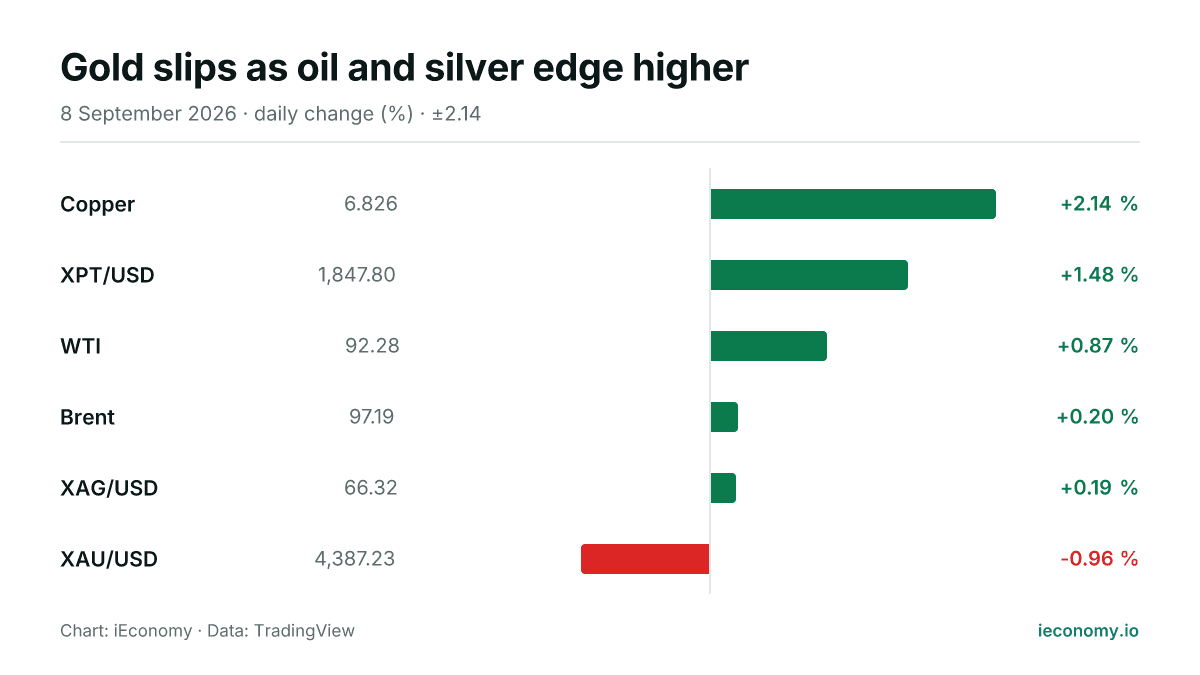
Gold fell on Tuesday while silver and the main crude benchmarks posted gains, leaving the complex mixed. Copper led the day’s advances, and the spread between the strongest and weakest moves was wide.
Gold slips as crude extends Monday gains
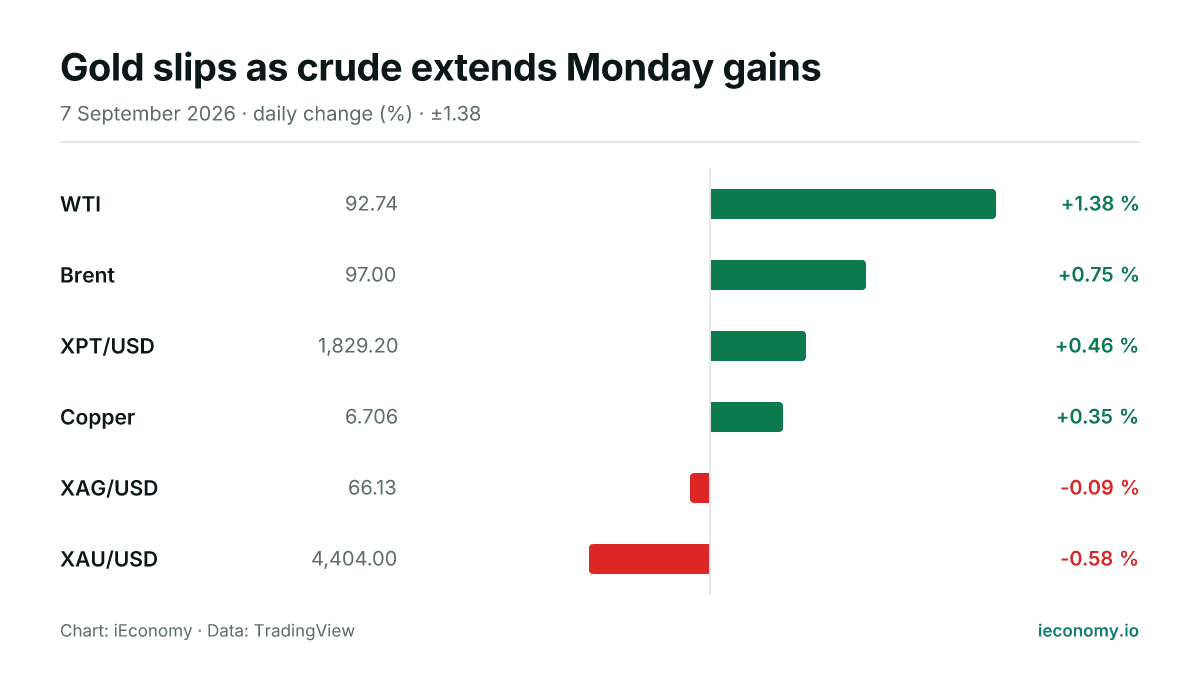
On Monday, crude oil led the commodity board higher while silver and gold edged lower. The session showed a broad but uneven move across tracked markets, with energy outperforming precious metals.
Gold and silver slide as crude oil extends gains
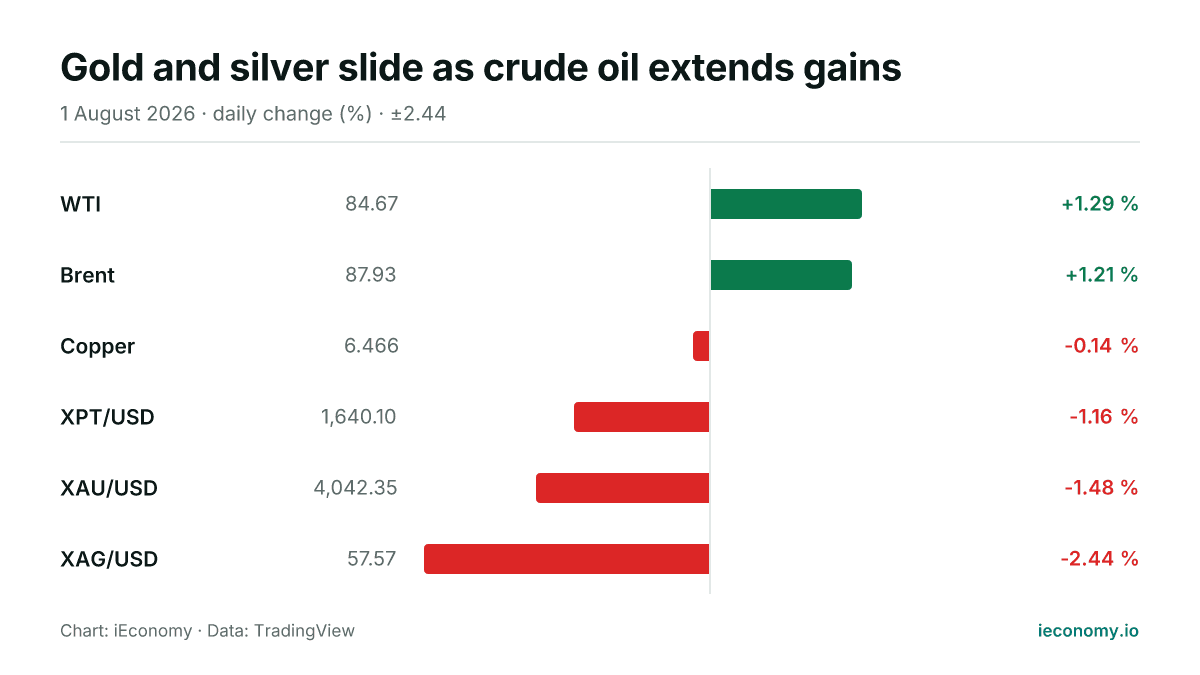
On Saturday, August 1, gold and silver were both lower, while WTI and Brent advanced. The moves leave the metals under pressure and keep crude on the firm side in mid-session trading.
Oil leads commodity gains as gold edges higher
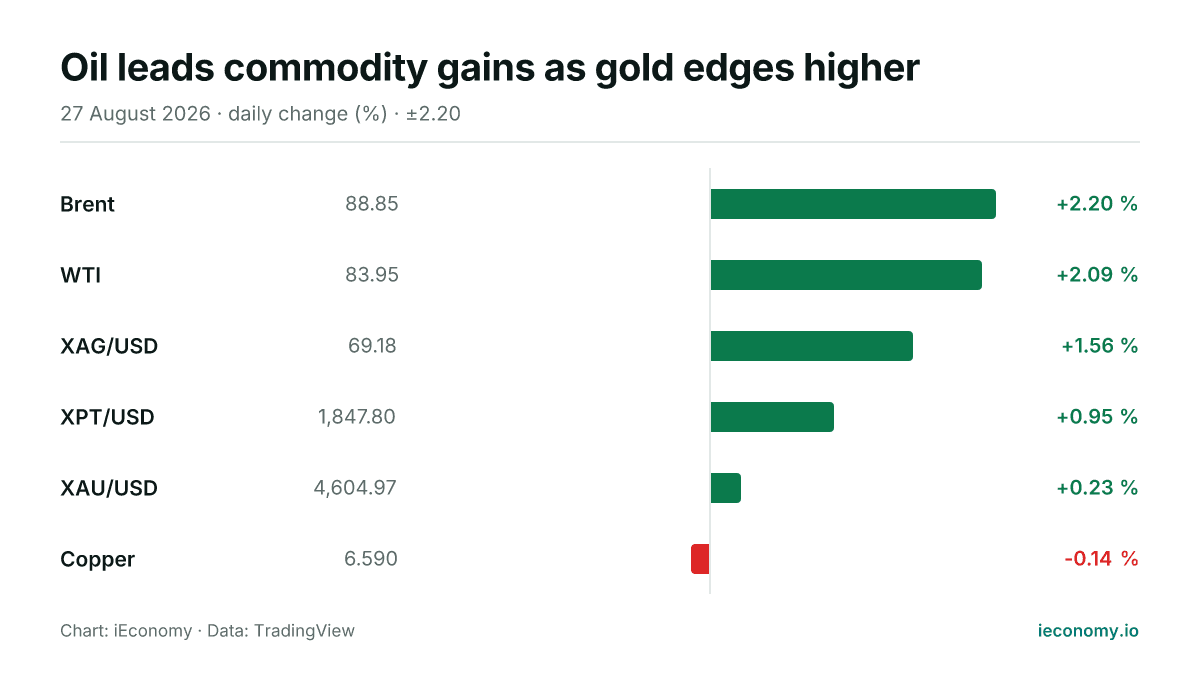
Crude oil outpaced the broader commodity board on Thursday, while silver and platinum also advanced. Gold rose more modestly and copper was the only tracked market to finish lower.
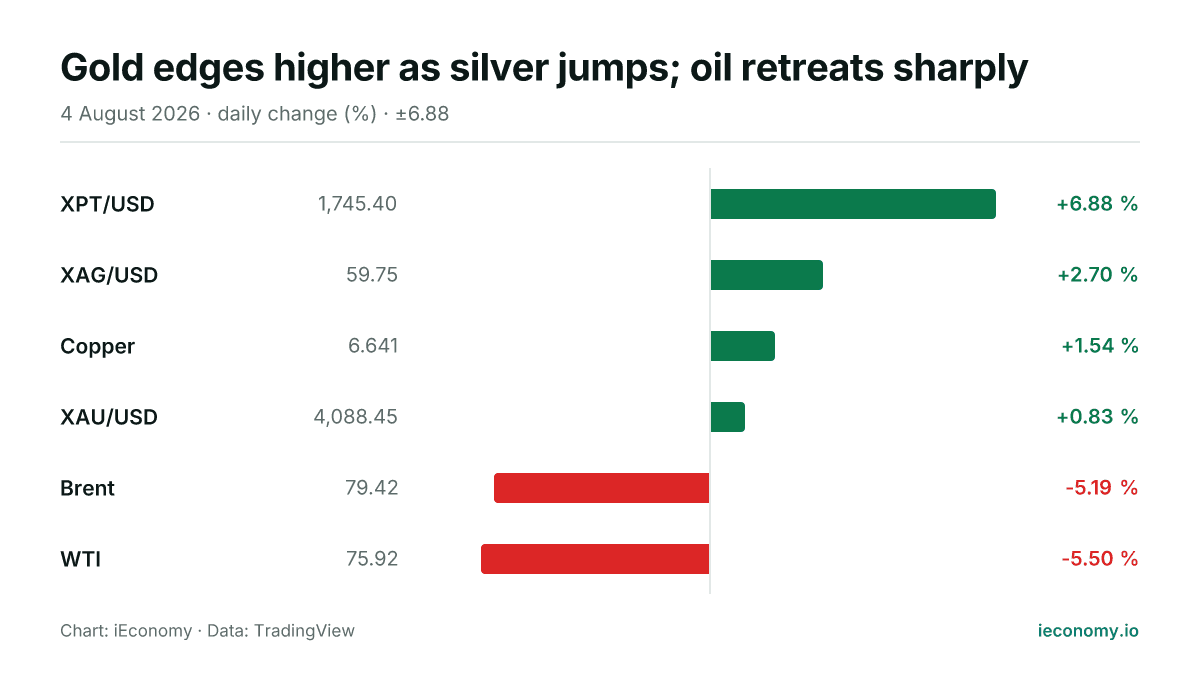
Gold edges higher as silver jumps; oil retreats sharply
Gold rose modestly while silver posted a stronger gain, as crude benchmarks fell more than 5% in late trading on Tuesday. The session left metals broadly firmer and energy notably weaker, with a wide spread between the day’s strongest and weakest moves.