Crude oil edges higher as Iran tensions keep markets tense
Oil prices rose modestly as renewed U.S.-Iran military action and threats around the Strait of Hormuz kept traders focused on potential supply disruption.

Quintin Soloviev / Wikimedia Commons (CC BY 4.0)
Crude oil prices moved slightly higher on Thursday as traders weighed fresh geopolitical risks against signs that the latest U.S. strikes on Iran may be time-limited. The market gave back some earlier gains, but concerns over supply disruption remained firmly in view. West Texas Intermediate for October delivery was last trading at $91.26 a barrel, up 24 cents, or 0.26%.
Hormuz remains the key risk
The latest price move came after a new round of tension between Washington and Tehran revived fears around shipping through the Strait of Hormuz, one of the world's most important oil chokepoints. The U.S. military recently carried out another set of strikes on Iran, targeting radar systems and mine-laying capabilities along the country's southern coast. Over the weekend, U.S. forces also hit launchers on Larak Island that were thought to be preparing mines for the strait.
Iran responded by attacking U.S. bases in Jordan, and that escalation prompted President Donald Trump to signal a further response. Trump also said the new wave of strikes on Iran would be only temporary, a remark that helped keep market expectations from becoming even more extreme. Still, the sequence of attacks and counterattacks has left energy traders focused on whether shipping lanes and regional infrastructure could be affected.
Markets weigh military moves and sanctions
The conflict has not been limited to military action. The U.S. Treasury Department also announced an economic blockade on Iran and warned that countries helping Tehran could face the same treatment. That mix of force and sanctions has added a second layer of uncertainty for oil traders, who are trying to judge whether the pressure on Iran will tighten supply or stay contained.
Some observers had expected Washington to lean more heavily on economic measures than on direct military action, which would have reduced the chance of a broader Middle East conflict. Instead, the renewed strikes suggest the situation remains fluid and difficult to predict. For oil markets, that means prices are being driven not just by current output, but by the possibility of sudden disruption in transit routes and regional exports.
The latest move in crude prices shows how sensitive the market remains to developments around Iran. Even a modest rise can matter when the underlying risk is tied to the movement of large volumes of global supply. For now, traders are watching whether the confrontation eases or whether further retaliation keeps the market on edge.
This article is not investment advice and recommends no asset, level or direction; a single session's move is not evidence of a trend. For background see Markets, Bear Market, BIST 100, and for terms the finance glossary.
Frequently asked questions
Why did crude oil rise on Thursday?
Oil rose because renewed U.S.-Iran tensions raised concerns about possible supply disruption, especially around the Strait of Hormuz.
What was WTI trading at?
WTI crude for October delivery was last seen at $91.26 a barrel, up 24 cents, or 0.26%.
What other measures did the U.S. take against Iran?
The U.S. Treasury Department announced an economic blockade on Iran and warned that countries helping Iran could face the same treatment.
Sources
Related News

Crude Oil Falls as Profit-Taking Follows Recent Gains
Oil prices slid after six straight sessions of advances as traders locked in profits and Washington escalated economic pressure on Iran, keeping Middle East risk in focus.
Crude Oil Rises as U.S.-Iran Tensions Shake Markets
Oil futures extended a two-day advance as fresh U.S. strikes on Iran and Tehran’s retaliation kept traders focused on supply risks tied to the Strait of Hormuz.
Crude oil jumps as U.S. expands strikes on Iran
Oil prices surged after Washington launched another round of strikes on Iran, reviving fears over Middle East supply risks and the Strait of Hormuz.
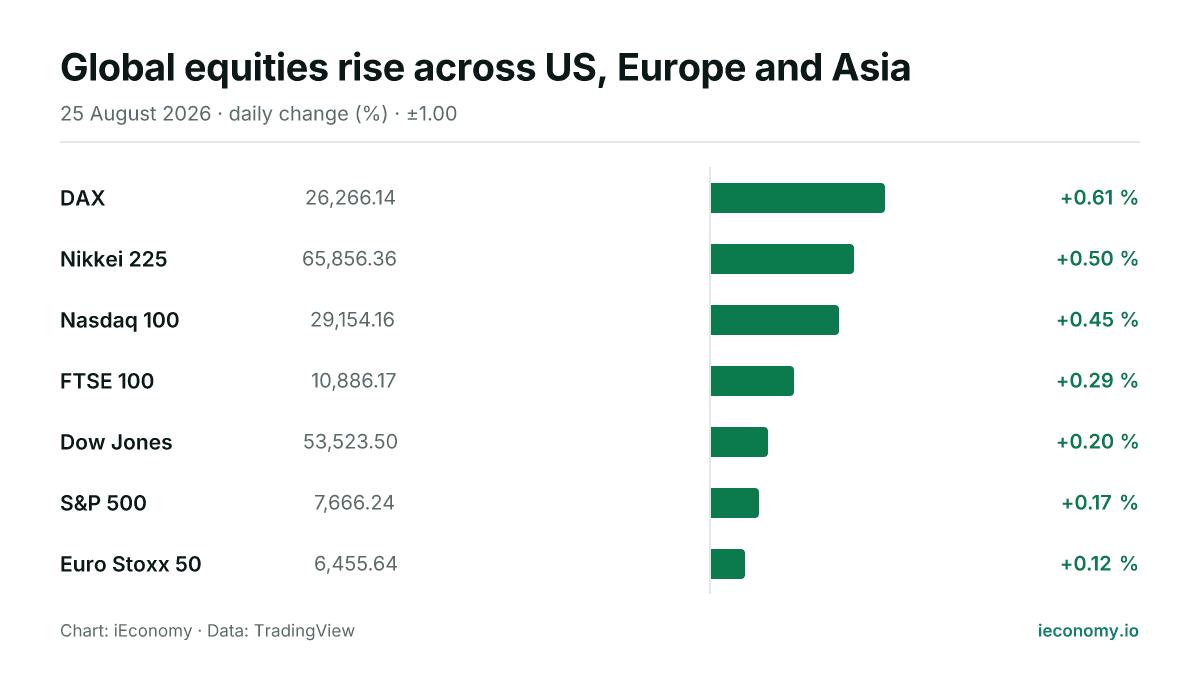
Global equities rise across US, Europe and Asia
All seven tracked benchmarks were higher on Tuesday, with gains led by Germany’s DAX and Japan’s Nikkei 225. The moves were broadly modest, leaving the day more notable for breadth than for size.
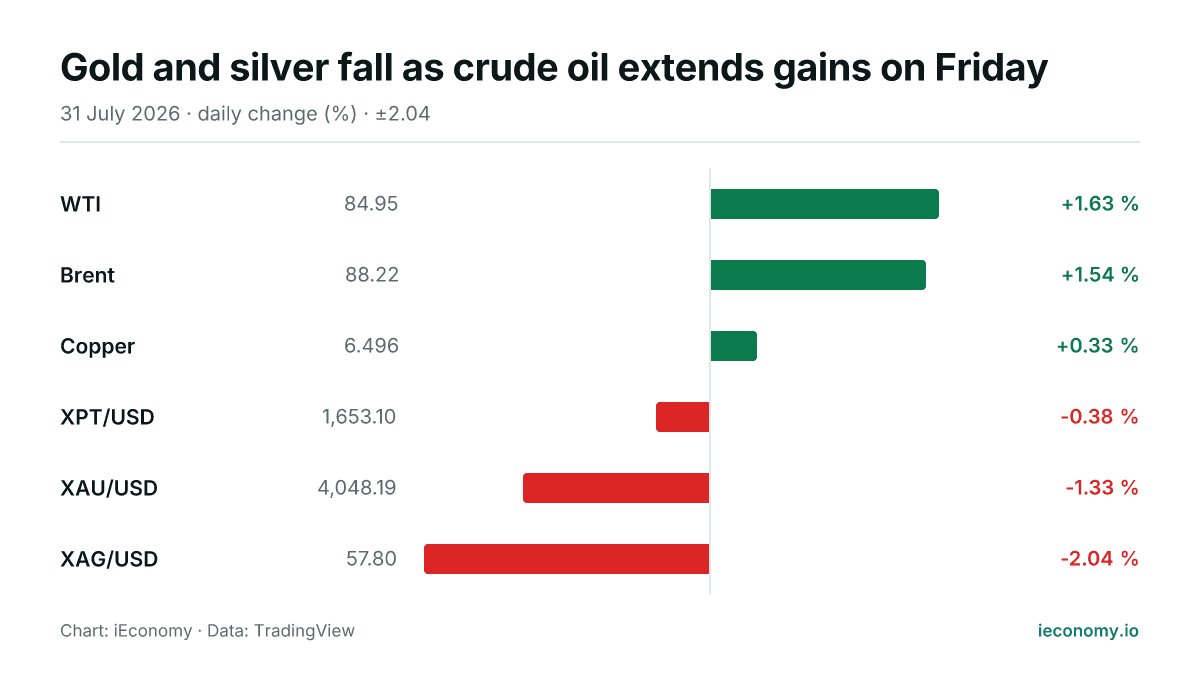
Gold and silver fall as crude oil extends gains on Friday
Gold and silver were lower while crude oil moved higher on 2026-07-31, with copper also slightly firmer. The day left a mixed commodity tape, led by strength in energy and weakness in precious metals.
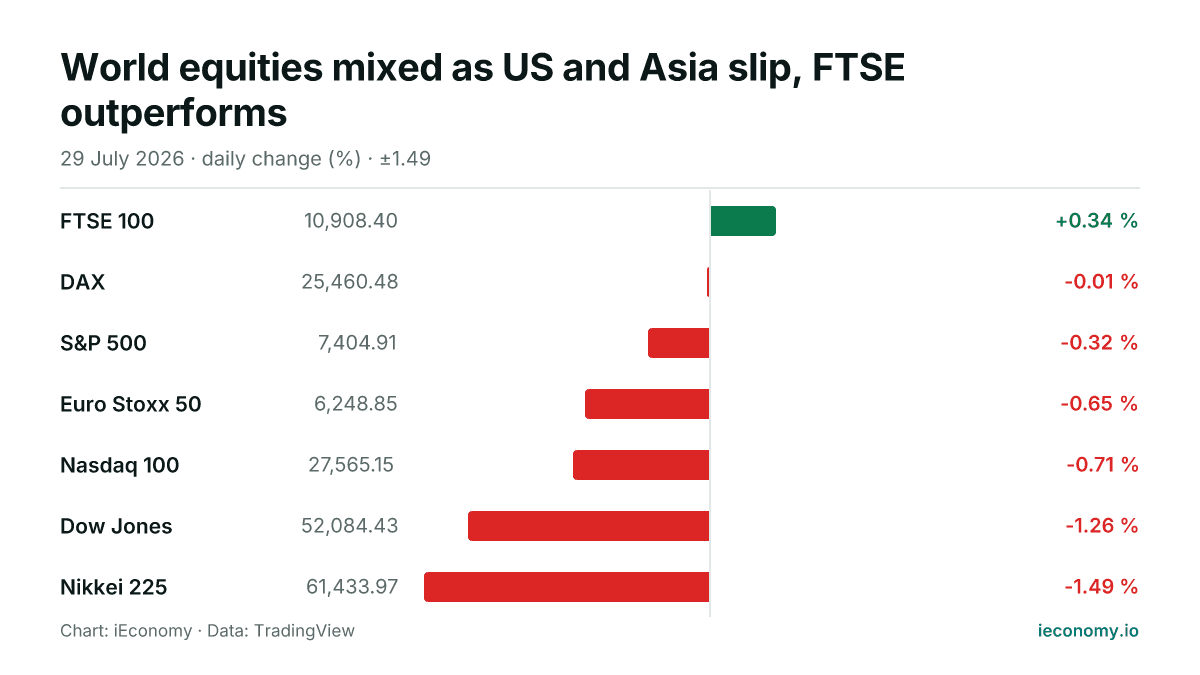
World equities mixed as US and Asia slip, FTSE outperforms
Global shares were mostly lower on Wednesday, with losses led by the Dow Jones and Nikkei 225 while the FTSE 100 edged higher. The DAX was almost unchanged, and the broader tone was one of modest pressure across US, European and Asian indices.