Crypto today: Solana speeds up disinflation
Solana validators approved a faster path to lower token issuance, California advanced restrictions on officials tied to memecoin launches, and World Liberty Financial’s banking plans drew fresh backing.

Jorge Franganillo / Wikimedia Commons (CC BY 2.0)
Solana validators have approved a change to the network’s monetary schedule that will reduce the pace of new SOL entering circulation more quickly than before. The decision raises the annual disinflation rate from 15% to 30%, a move designed to bring the token’s long-term inflation target into view sooner.
Solana cuts the time to its inflation target
The proposal, known as SGP-0002, received 67% support from validators. A further 25.16% voted against it, while 7.84% abstained, and nearly 61% of eligible stake took part in the vote. Under the revised schedule, Solana is still aiming for a 1.5% inflation rate over the long run, but the network expects to get there in about 2.8 years rather than 5.7 years.
The shift matters because Solana’s issuance path affects how quickly supply expands and how the market absorbs newly created tokens. Slower growth in supply can change the balance between emissions, staking incentives and demand expectations, even if it does not alter the network’s broader design or its target inflation level.
California takes aim at memecoin conflicts
In the United States, California lawmakers passed a bill that would limit the involvement of public officials in memecoin issuance. The measure reflects growing political scrutiny of crypto-linked fundraising and promotion, particularly where officials or their associates could benefit from a token launch.
The legislation does not change market pricing directly, but it adds another layer of regulatory attention to a segment of the crypto market that has often relied on attention, speculation and personality-driven branding. For traders and builders, that kind of policy move can affect how aggressively new projects are marketed and who is willing to participate in them.
A separate development involved World Liberty Financial’s planned US trust bank. A group linked to an Abu Dhabi royal reportedly backed a 49% stake in the holding company behind the project, adding fresh support to its proposed banking ecosystem. The structure suggests continued interest in blending crypto-related services with conventional financial infrastructure.
Taken together, the three developments show how crypto’s market drivers now span protocol governance, state-level regulation and capital backing for banking ambitions. Solana’s vote changes token issuance mechanics, California’s bill raises the bar for official involvement in memecoin launches, and the World Liberty Financial report points to ongoing competition to build regulated on-chain financial services.
This article is not investment advice and recommends no asset, level or direction; a single session's move is not evidence of a trend. For background see Crypto, Altcoin, Bitcoin, and for terms the finance glossary.
Frequently asked questions
What did Solana validators approve?
They approved a proposal to double the network’s annual disinflation rate from 15% to 30%.
What does the California bill address?
It restricts public officials’ involvement in memecoin issuance.
What happened with World Liberty Financial’s bank plan?
A group linked to an Abu Dhabi royal reportedly backed a 49% stake in the holding company behind its proposed US trust bank.
Sources
Related News
Abu Dhabi royal backs stake in Trump-linked crypto bank
A group linked to Abu Dhabi royal Sheikh Tahnoon bin Zayed Al Nahyan reportedly holds 49% of the company behind World Liberty Financial’s proposed US trust bank.
Crypto tax activity seen at $457B as CARF gap widens
Chainalysis says potentially taxable onchain crypto activity reached at least $457 billion in 2025, but OECD reporting rules may cover only a small share.
Crypto Today: Strategy pauses BTC buys after $2B raise
Strategy raised about $2 billion through share sales, created a $1.6 billion cash reserve and did not add to its Bitcoin stash. Pakistan also set a licensing deadline for crypto firms.
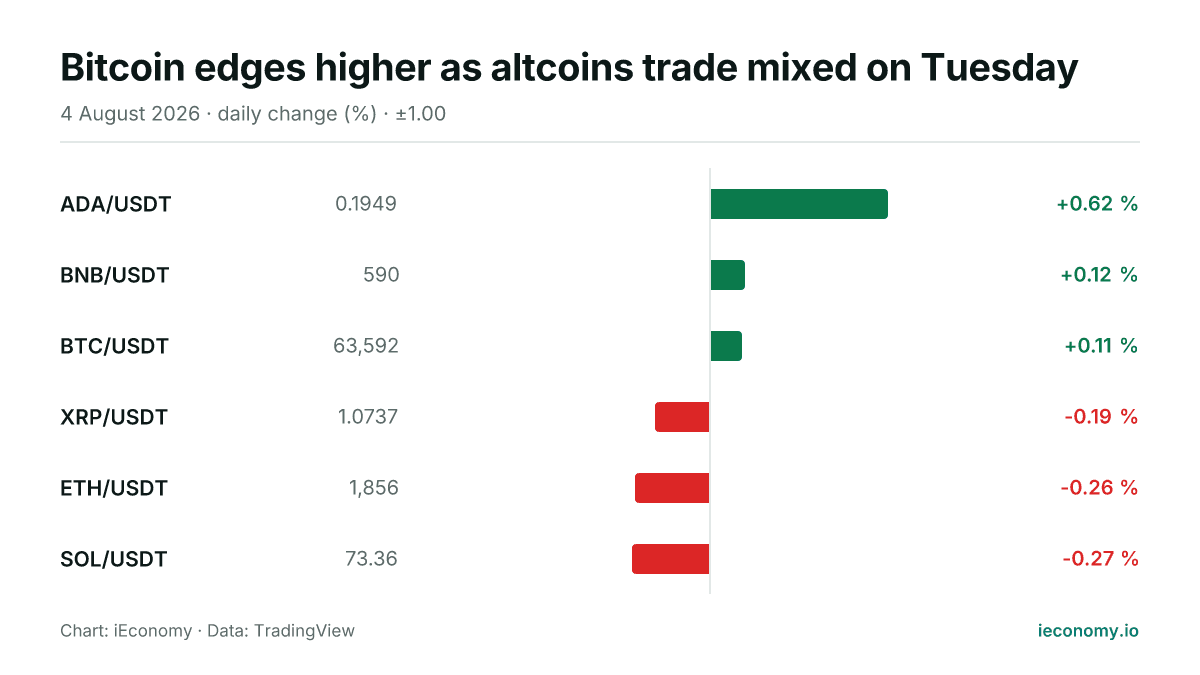
Bitcoin edges higher as altcoins trade mixed on Tuesday
Crypto markets were mixed on Tuesday, with bitcoin and BNB posting modest gains while ether, XRP and SOL slipped. The day’s moves were small in percentage terms, pointing to a largely range-bound session rather than a broad directional break.

Crypto phishing campaign targets 885,000 phone numbers
Rapid7 says a phishing operation dubbed Asterix targeted about 885,000 phone numbers across several countries, with logs tied to Binance users and fake Crypto.com emails.

Ethereum Outpaces Bitcoin as Network Upgrade Momentum Builds
The second-largest cryptocurrency posted its strongest weekly gain in months ahead of an anticipated network upgrade.