Indian shares fall as oil jumps on Middle East tensions
Indian equities retreated as Brent approached $100 a barrel on Middle East tensions, stoking inflation and Fed-rate worries. Losses in large caps outweighed gains in mid- and small-caps.

Indian shares finished lower on Tuesday after a surge in crude prices revived inflation concerns and added to worries that the U.S. Federal Reserve could keep policy tighter for longer. The selloff came as investors assessed escalating Middle East tensions, which pushed Brent crude futures close to the $100-a-barrel mark. Higher energy costs are a sensitive issue for India because they can feed into import bills, corporate margins and consumer prices.
Oil prices drive inflation fears
The backdrop for the move was a sharper risk-off tone in global markets. Iran threatened retaliation if the United States launches fresh attacks on its assets, while Saudi-led coalition forces signaled a firm response to Houthi attacks. Traders were also watching for details of an Iranian arrangement with Oman aimed at managing shipping through the Strait of Hormuz, a crucial route for global energy flows.
The rise in crude matters for Indian equities because it can raise input costs across sectors and make inflation harder to contain. That, in turn, can complicate the outlook for monetary policy abroad and keep investors cautious on risk assets. Financial markets have been especially sensitive to the possibility that stronger commodity prices could affect the Federal Reserve's next moves.
Large-cap weakness weighs on benchmarks
The benchmark BSE Sensex lost 555.23 points, or 0.73%, to close at 75,577.58. The NSE Nifty 50 fell 144.05 points, or 0.61%, to 23,635.10. Despite the decline in headline indexes, the broader market was somewhat firmer: the BSE mid-cap index rose 0.3% and the small-cap index added 0.2%.
Market breadth on the BSE was negative overall, with more stocks declining than advancing. Among the notable losers were Maruti Suzuki India, Sun Pharma, HDFC Bank, Reliance Industries, Kotak Mahindra Bank, UltraTech Cement, Axis Bank and ICICI Bank, each down roughly 1% to 2%. The pattern suggests that selling pressure was concentrated in heavyweight names even as some smaller stocks held up better.
For market participants, the session showed how quickly geopolitical risk can spill into local equities through the oil channel. India remains exposed to higher crude because it imports much of its energy needs, so persistent gains in oil tend to ripple through inflation expectations and company costs. That leaves large, domestically important stocks vulnerable when global commodity markets turn volatile.
This article is not investment advice and recommends no asset, level or direction; a single session's move is not evidence of a trend. For background see Stocks, Bear Market, BIST 100, and for terms the finance glossary.
Frequently asked questions
Why did Indian shares fall?
They slipped as oil prices climbed on Middle East tensions, which raised inflation worries and fed concern about a possible Federal Reserve rate hike.
Which indexes were hit the hardest?
The BSE Sensex and NSE Nifty both ended lower, while mid-cap and small-cap shares posted small gains.
Which stocks were among the biggest decliners?
Maruti Suzuki India, Sun Pharma, HDFC Bank, Reliance Industries, Kotak Mahindra Bank, UltraTech Cement, Axis Bank and ICICI Bank were among the prominent losers.
Sources
Related News

Canada tariffs hit $27.6 billion in U.S. goods
Canada has imposed fresh retaliatory tariffs of 15% to 50% on $27.6 billion of U.S. products, doubling duties on steel and aluminum as trade talks with Washington break down.

Amazon cargo jet overran Miami runway, NTSB says
A cargo jet operating for Amazon ran off the runway at Miami International Airport, struck two vehicles and killed multiple people, as investigators recovered the flight recorders.
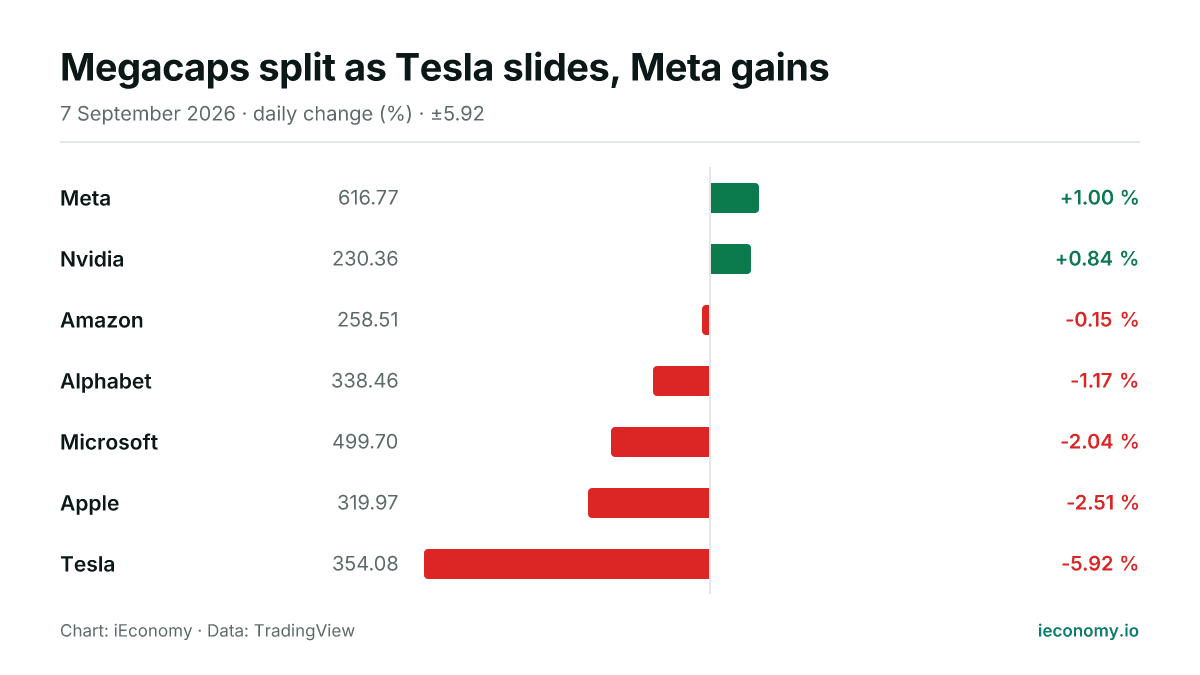
Megacaps split as Tesla slides, Meta gains
US megacaps traded unevenly on Monday, with Meta and Nvidia higher while Apple, Microsoft, Alphabet, Amazon and Tesla were lower. The moves point to a broad risk reset rather than a single-stock story.

Oil slips on Pakistan-led push for U.S.-Iran talks
Crude fell after a report said Pakistan is seeking to revive U.S.-Iran negotiations with Chinese support, even as Middle East fighting keeps weekly gains intact.
Oil extends losses as U.S.-Iran tensions cool
Crude futures fell again as signs of a temporary lull in U.S.-Iran fighting eased fears of supply disruption, though traders still face risks around Hormuz.

Fed mention market sees Warsh saying 'shock' and 'oil'
Kalshi traders are pricing a high chance that Fed Chair Kevin Warsh will reference last week’s energy shock at Wednesday’s press conference as the central bank is expected to keep rates steady.