Bitcoin's Consolidation Phase: Assessing Risk Amid Macro Uncertainty
Bitcoin trades at $64,138, showing short-term resilience with a neutral RSI of 49.6, yet remains down sharply year-to-date. The asset is caught between a constructive technical base and persistent macro headwinds, with its trajectory likely dependent on liquidity conditions and institutional adoption flows.
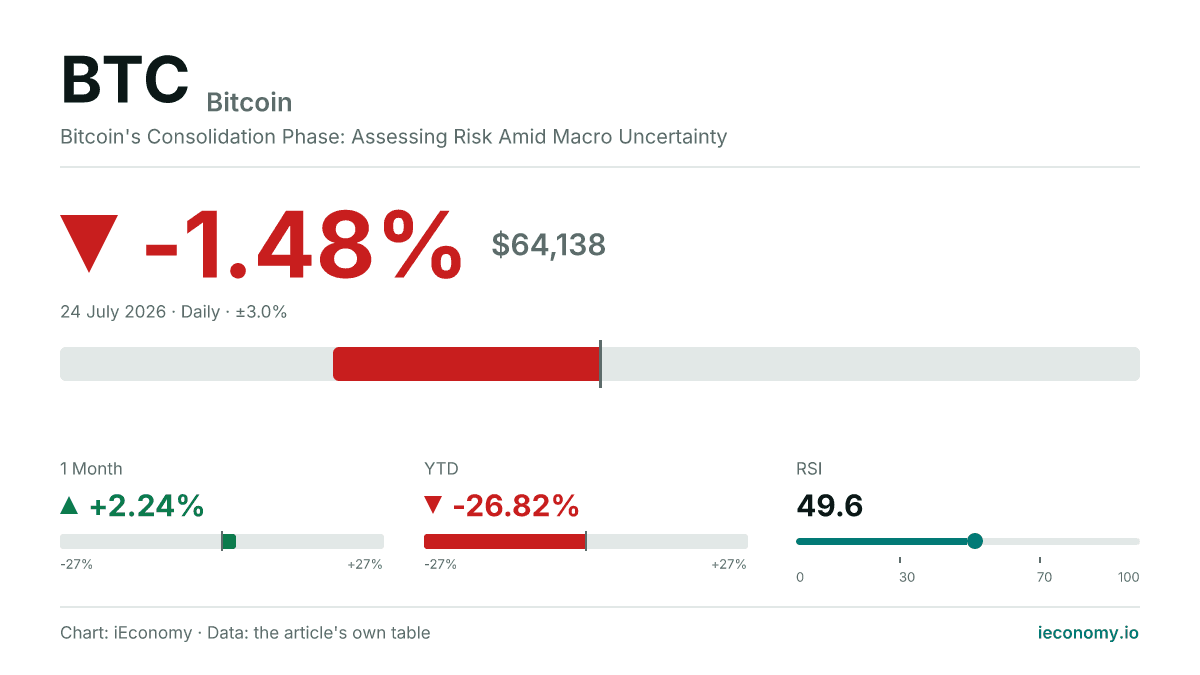
Chart: iEconomy · Data: the article's own table
Bitcoin's price action on July 24, 2026, at $64,138, reflects a market in a state of equilibrium, digesting a significant year-to-date decline of 26.82%.
The daily loss of 1.48% is modest within the context of recent volatility, while a modest one-month gain of 2.24% suggests a tentative stabilization. The 14-day RSI reading of 49.6 places the asset squarely in neutral territory, indicating neither overbought nor oversold conditions on this timeframe.
This data paints a picture of an asset consolidating after a bearish trend, with momentum currently balanced.
| Indicator | Value |
|---|---|
| Last price (USD) | 64,138 |
| Daily | -1.48% |
| 1 Month | +2.24% |
| YTD | -26.82% |
| RSI (14) | 49.6 |
Macro and Sectoral Drivers
The primary driver for Bitcoin remains the global liquidity environment and its perception as a risk-on, non-correlated asset. Its year-to-date underperformance is consistent with periods of monetary tightening or risk aversion in traditional markets.
Sectorally, Bitcoin continues to be influenced by regulatory developments, the pace of institutional adoption via ETFs and corporate treasuries, and the evolving narrative around its utility as a digital store of value versus a speculative asset.
Network fundamentals, such as hash rate and on-chain activity, provide a structural backdrop but are currently secondary to macro sentiment in driving short-term price action.
Technical Picture and Market Structure
The neutral RSI of 49.6 suggests a lack of strong directional momentum in the near term, often a characteristic of a consolidation or distribution phase. It follows a period where the asset was likely oversold, given the steep YTD decline.
The positive one-month performance of 2.24%, while slight, indicates a potential attempt to establish a base. Technically, the price is wrestling with the psychological $65,000 level. A sustained break above this zone, confirmed by a rising RSI moving towards 60, could signal a shift in near-term sentiment.
Conversely, failure to hold current levels, leading the RSI back towards oversold territory below 40, would suggest the bearish trend remains dominant.
Fundamental and Structural View
Structurally, Bitcoin's network security and fixed supply schedule remain its core investment thesis. The 'halving' cycle, a pre-programmed reduction in new supply, continues to provide a long-term scarcity model. However, in the current cycle, this fundamental driver is being overshadowed by macro forces.
Adoption metrics are critical; sustained inflows into spot Bitcoin ETFs or increased on-chain accumulation by long-term holders would be fundamental positives. Conversely, a stagnation or reversal in these metrics would underscore the asset's continued sensitivity to speculative flows and broader financial conditions.
Conditional Scenarios and Trajectories
A bullish scenario would require a catalyst that improves macro liquidity expectations or a significant positive regulatory development.
In such a case, if Bitcoin can reclaim and hold above the $70,000 level with rising volume, the neutral RSI could quickly transition to bullish momentum, potentially targeting a test of the year's highs.
The base case, supported by the current neutral RSI and slight monthly gain, is for continued range-bound trading between $60,000 and $70,000 as the market awaits clearer directional cues. A bearish scenario would materialize if macro conditions deteriorate further, prompting a risk-off flight.
A decisive break below the $60,000 support level, accompanied by the RSI falling into the 30s, could open a path toward retesting the YTD lows, extending the current downtrend.
Key Risks and Monitoring Points
The principal risk remains an exogenous macro shock that triggers broad deleveraging across risk assets, of which Bitcoin is still largely considered a part. Regulatory uncertainty in major economies also poses a persistent threat.
Internally, a decline in network hash rate or a major security incident, while unlikely, would be structurally damaging.
Key metrics to watch include the RSI for shifts from its neutral posture, the $60,000 and $70,000 levels for breakout or breakdown signals, and on-chain data for changes in holder behavior.
Furthermore, correlations with traditional risk assets like the Nasdaq should be monitored, as decoupling could signal a maturation of Bitcoin's value proposition, while strengthening correlation would confirm its current risk-asset status.
Sources
Related News

BNB Surges 7% in a Day, Outpacing Broader Crypto Market
Binance's native token posted a sharp single-day gain. We examine the typical mechanics behind such altcoin moves and what they mean for long-term trends.

Mirae Asset maps $109B crypto push for Digital X
Mirae Asset is building a digital asset strategy around Digital X, with plans spanning crypto, stablecoins and tokenized assets after taking control of Korbit.
Bitcoin slips as altcoins mostly fall on Tuesday
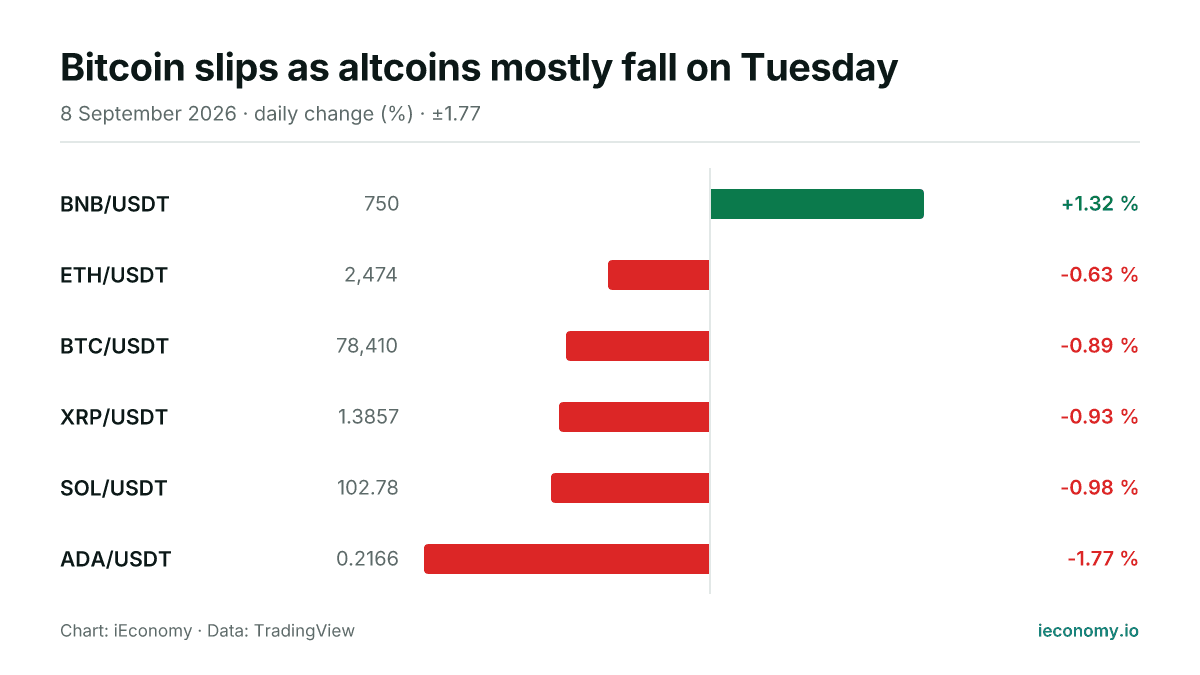
Bitcoin and ether traded lower on Tuesday, while five of the six large-cap tokens in the digest were in the red or flat. BNB was the lone gainer, showing a narrow pocket of relative strength.
Minnesota crypto ATM ban takes effect after scam losses
Minnesota’s ban on crypto ATMs is now in force after state officials said residents, especially older adults, lost about $1 million to kiosk-linked scams over two years.
Bitcoin demand test builds above $83,000
Glassnode says Bitcoin is pressing into a dense band of overhead supply between $81,000 and $86,000, where long-term holders and key trend lines may cap momentum.
Crypto education gap pushes students to social media
An OKX survey shows 90% of US students want crypto classes, but a lack of formal courses makes social media their primary learning source.