Ethereum Navigates Crosscurrents: Technical Resilience Meets Structural Headwinds
Ethereum exhibits near-term technical stability with a neutral RSI and solid monthly gains, yet remains deeply in negative territory year-to-date. Analysis focuses on the conditional interplay between network fundamentals, macro sentiment, and key technical levels ahead of major protocol developments.
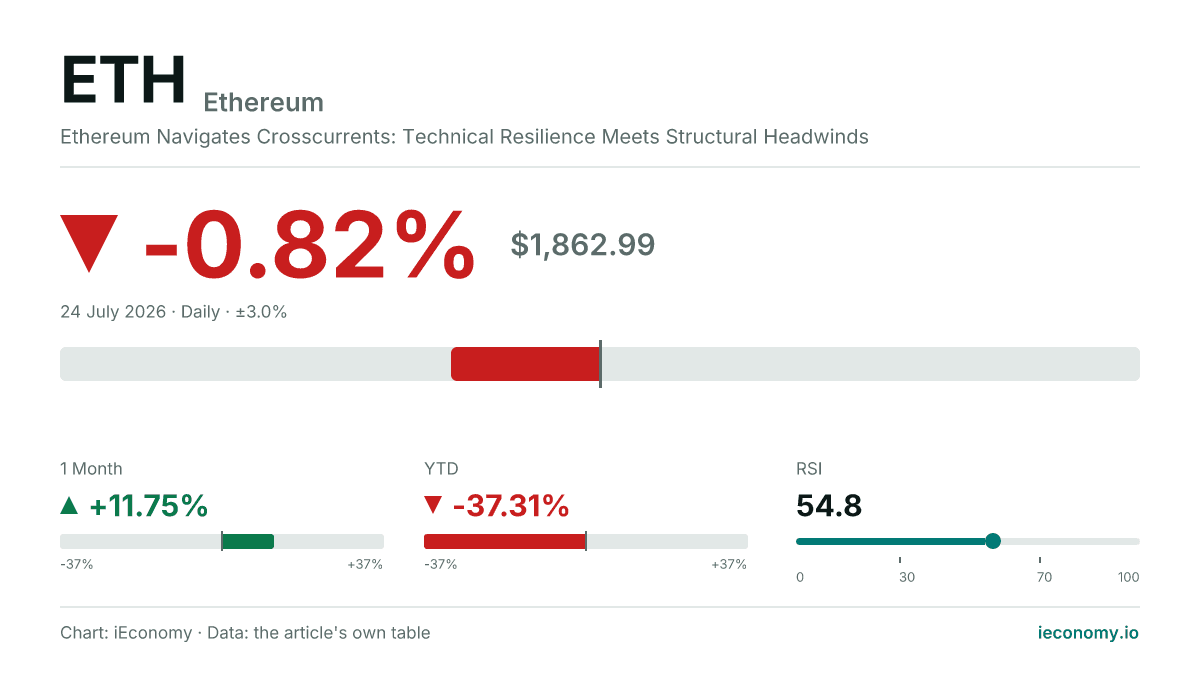
Chart: iEconomy · Data: the article's own table
Ethereum presents a bifurcated performance picture as of late July 2026. The asset trades at $1,863, reflecting modest daily pressure but demonstrating notable resilience over a one-month horizon with an 11.75% gain.
This near-term strength, occurring alongside a neutral 14-day RSI of 54.8, suggests a period of consolidation after previous volatility. However, the stark year-to-date decline of -37.31% underscores persistent structural and macro headwinds that have dominated the broader digital asset landscape.
The current thesis centers on Ethereum navigating between improving on-chain fundamentals and scalability narratives against a backdrop of lingering regulatory uncertainty and competitive pressures.
| Indicator | Value |
|---|---|
| Last price (USD) | 1,862.99 |
| Daily | -0.82% |
| 1 Month | +11.75% |
| YTD | -37.31% |
| RSI (14) | 54.8 |
Macro and Sector Drivers
The primary macro driver remains the trajectory of global risk appetite, heavily influenced by central bank policy and traditional equity market performance. Ethereum's deep YTD drawdown aligns with a risk-off environment that has particularly impacted growth-oriented and technological assets.
Within the digital asset sector, Ethereum continues to be a benchmark for smart contract platform viability. Its performance is increasingly decoupled from pure monetary network assets like Bitcoin, instead reflecting sentiment on decentralized application (dApp) activity, developer momentum, and the success of its scaling roadmap.
Sector-specific pressures include regulatory scrutiny on staking and DeFi, alongside competition from alternative Layer 1 and Layer 2 solutions vying for developer mindshare and total value locked (TVL).
Technical Picture and Interpretation
The provided metrics sketch a technically neutral to cautiously constructive short-term setup. The 14-day RSI of 54.8 resides squarely in neutral territory, indicating neither overbought nor oversold conditions and suggesting a lack of extreme momentum in either direction.
This aligns with the price action, which shows a minor daily decline of -0.82% but a significant monthly advance of +11.75%. This combination could be interpreted as a healthy consolidation or digestion of recent gains.
Technically, the ability to maintain levels above key psychological support (e.g., the $1,800 area) while building on the monthly performance would be viewed as constructive.
Conversely, a failure to hold recent gains and a breakdown from this consolidation zone could see the RSI retreat towards oversold levels, reigniting the dominant YTD downtrend.
Fundamental and Structural View
Fundamentally, Ethereum's value proposition hinges on its evolution into a scalable, secure settlement layer. The successful implementation and adoption of its ongoing upgrades—focusing on rollup-centric scaling, staking sustainability, and account abstraction—are critical.
Network activity metrics, such as fee revenue, active addresses, and TVL across its Layer 2 ecosystem, provide a more nuanced view than price alone.
A structurally bullish case is conditional on continued growth in these usage metrics, successful execution of the protocol roadmap, and Ethereum maintaining its dominance as the primary settlement layer for the broader Web3 stack.
The bear case revolves around scalability progress lagging user demand, regulatory actions stifling core use cases like DeFi, or a failure to sufficiently reduce transaction costs for end-users, ceding ground to competitors.
Conditional Forward Scenarios
A bullish scenario, conditional on a broad improvement in risk sentiment and positive catalysts from network development, would see Ethereum building on its monthly momentum.
This could involve a sustained move above the $2,000 resistance level, supported by rising on-chain activity and a corresponding RSI moving into bullish territory (above 60). The base case involves continued range-bound trading between approximately $1,700 and $2,100.
This scenario assumes a status quo in macro conditions and steady, unspectacular progress on network upgrades, with the RSI oscillating in its neutral range. A bearish scenario, triggered by a deterioration in macro conditions or a negative sector-specific development, would see the YTD downtrend resuming.
This could involve a break below key support, leading to a test of lower levels and the RSI falling back into oversold territory (below 30), potentially exacerbating the already significant YTD loss.
Key Risks and Monitoring Points
Principal risks include regulatory overhang, particularly concerning staking and token classification, which could impact network participation and institutional adoption. Execution risk on the protocol's complex technical roadmap remains ever-present, as delays or bugs could undermine confidence.
Competitive risk from other smart contract platforms and even scalable Bitcoin layers is intensifying. From a market structure perspective, liquidity conditions and derivatives market positioning warrant close observation.
Key metrics to watch extend beyond price to include the health of the Layer 2 ecosystem (transaction volume, costs), staking participation rates and yields, network fee trends, and developer activity.
Any significant divergence between positive on-chain fundamentals and negative price action would present a critical analytical puzzle, while congruence between the two would reinforce the prevailing trend.
Sources
Related News

BNB Surges 7% in a Day, Outpacing Broader Crypto Market
Binance's native token posted a sharp single-day gain. We examine the typical mechanics behind such altcoin moves and what they mean for long-term trends.

Mirae Asset maps $109B crypto push for Digital X
Mirae Asset is building a digital asset strategy around Digital X, with plans spanning crypto, stablecoins and tokenized assets after taking control of Korbit.
Crypto education gap pushes students to social media
An OKX survey shows 90% of US students want crypto classes, but a lack of formal courses makes social media their primary learning source.
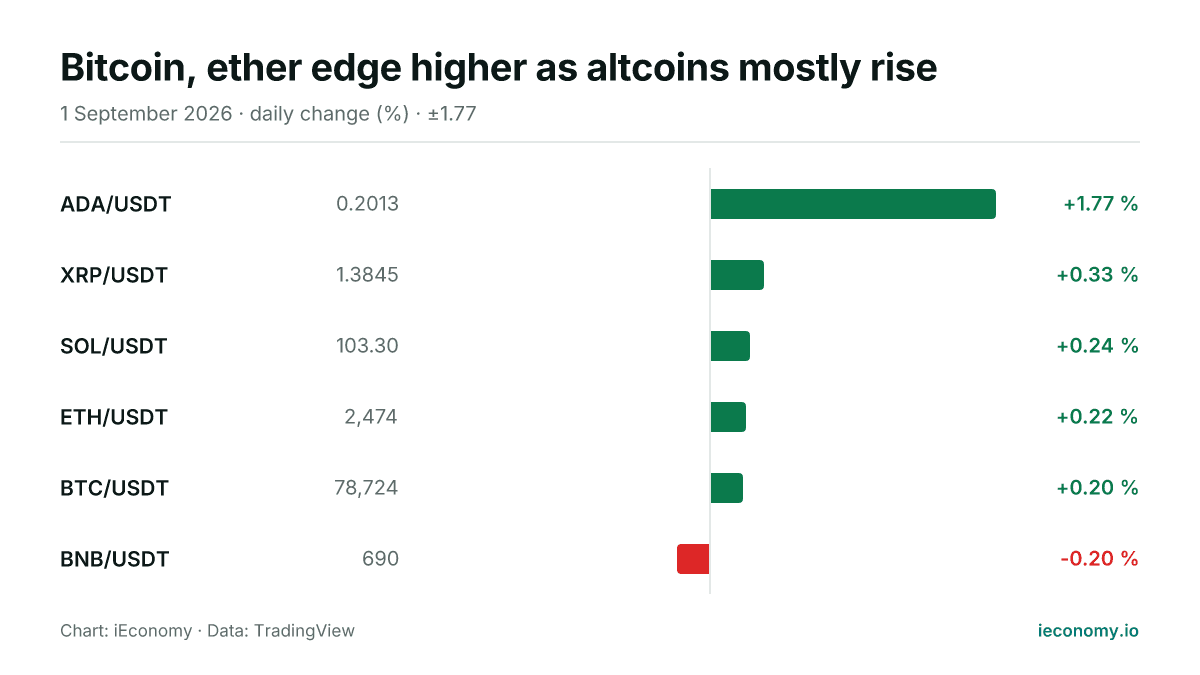
Bitcoin, ether edge higher as altcoins mostly rise
Bitcoin and ether traded modestly higher on Tuesday, while most large-cap altcoins also advanced. BNB was the lone decliner in a narrow session that kept moves contained across the board.

XRP Gains 12.78% in a Day: What Drives Such Moves?
XRP surged over 12% in a single session. We examine the typical mechanics behind such altcoin volatility and what a daily move does—and does not—signal.

USDC Expands to OKX's X Layer Network
Circle integrates its stablecoin and cross-chain protocol into the Ethereum-compatible layer-2 network, connecting USDC to a major crypto exchange ecosystem.