Europe leads as US tech slips, Asia edges higher
European benchmarks outperformed on Sunday, while Asian equities were firmer and the main US averages finished lower. The day’s moves were modest in some cases, but the spread between winners and laggards was clear.
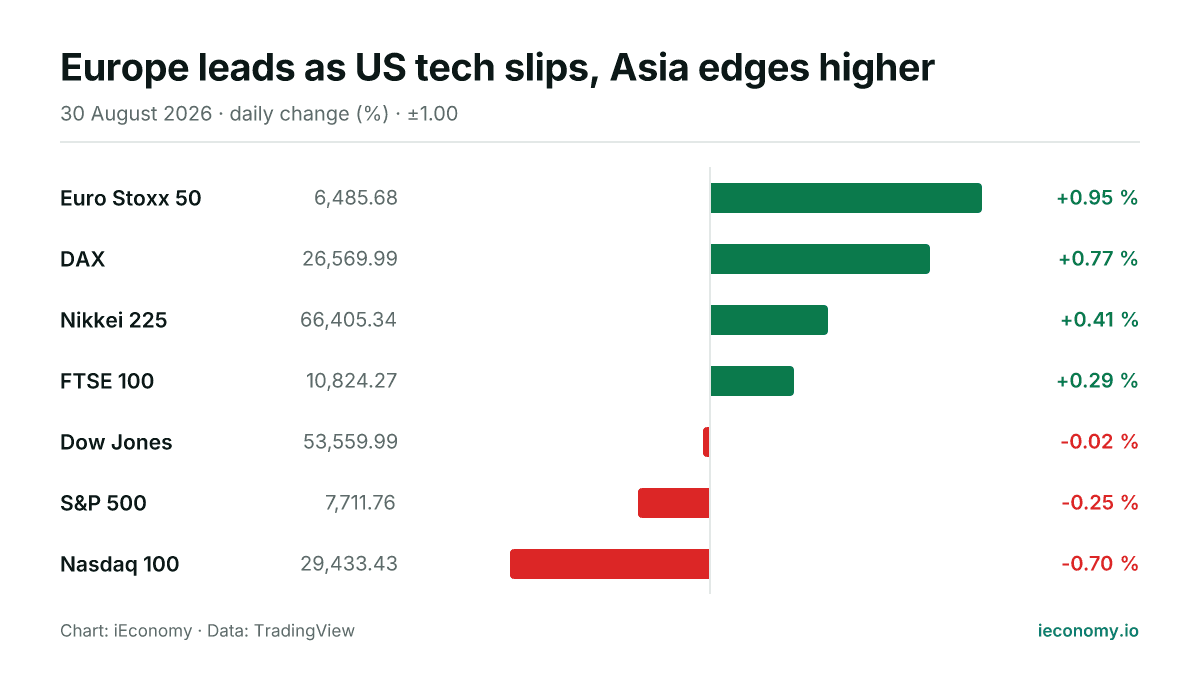
Chart: iEconomy · Data: TradingView
World equity indices were mixed on Sunday, with Europe setting the pace, Asia also higher, and the main US benchmarks slightly weaker. The dispersion was enough to show rotation across regions and styles, even though the day’s moves were not large by historical standards.
What moved and by how much
European shares led the board. The Euro Stoxx 50 rose 0.95% to 6,485.68, while the DAX gained 0.77% to 26,569.99. The FTSE 100 added 0.29%, leaving the UK blue-chip index behind continental peers but still in positive territory.
| Instrument | Last | Change |
|---|---|---|
| Euro Stoxx 50 | 6,485.68 | +0.95 % |
| DAX | 26,569.99 | +0.77 % |
| Nikkei 225 | 66,405.34 | +0.41 % |
| FTSE 100 | 10,824.27 | +0.29 % |
| Dow Jones | 53,559.99 | -0.02 % |
| S&P 500 | 7,711.76 | -0.25 % |
| Nasdaq 100 | 29,433.43 | -0.70 % |
Asian equities were firmer as well, but by a smaller margin. The Nikkei 225 advanced 0.41% to 66,405.34, extending the day’s broad preference for risk over outright defensive positioning. That left the region in the middle of the global range rather than at either extreme.
US indices were the soft spot. The Dow Jones edged down 0.02%, while the S&P 500 fell 0.25% and the Nasdaq 100 dropped 0.70%. The gap between the Dow and the technology-heavy Nasdaq showed that the day was more about style differences than a uniform market sell-off.
The standouts at each end
At the top of the table, the Euro Stoxx 50 was the strongest of the seven tracked instruments. Its lead over the US benchmarks suggests a session in which investors favoured European large caps over American growth shares, at least for the moment.
At the other end, the Nasdaq 100 was the weakest by a clear margin. That matters because index-level declines often reflect the weighting of a small number of large constituents, so a move there can have an outsized effect on broader sentiment even when other benchmarks are close to flat.
The Dow Jones barely moved, which is a reminder that a headline index can hide internal contrasts. In practice, small daily changes often come from a mix of sector rotation, position adjustments and calendar effects, rather than any single broad market verdict.
What a long-term investor should take from one day
One session does not change the longer-term trend by itself. The main takeaway is that global equity leadership can shift from region to region and from growth to value within the same day, so short-term performance should be read as noise unless it persists.
For a long-term holder, the mechanics matter more than the headline direction. When some markets rise and others fall, index construction, sector weights and investor positioning can drive outcomes as much as overall risk appetite. That is why single-day moves are informative, but rarely decisive.
The current picture also shows that diversification can work in both directions: it can soften drawdowns, but it can also mean not every market participates equally in a rally. On a day like this, that is the central risk to keep in mind.
This article is not investment advice and recommends no asset, level or direction; a single session's move is not evidence of a trend. For background see Markets, Bear Market, BIST 100, and for terms the finance glossary.
Frequently asked questions
Which region was strongest on the day?
Europe was strongest, led by the Euro Stoxx 50 and the DAX. The region outperformed both Asia and the US on the day, with all three major European benchmarks in positive territory.
Did the US market move as a single block?
No. The Dow Jones was almost unchanged, the S&P 500 was lower, and the Nasdaq 100 fell more sharply. That split points to differences between sectors and index composition rather than a uniform move across all US equities.
What should readers focus on after a mixed session?
Focus on relative performance and market breadth, not just the direction of the headline index. A mixed day like this can reflect rotation across regions and styles, which is useful context but not, on its own, a signal for what comes next.
Sources
Related News
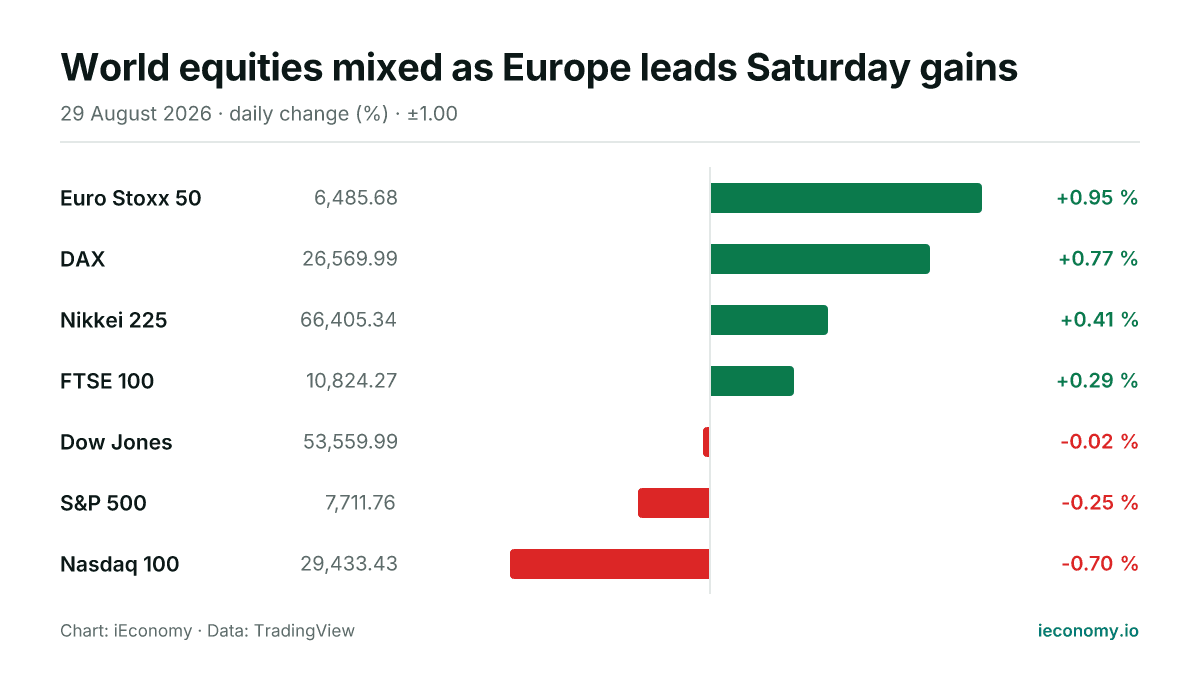
World equities mixed as Europe leads Saturday gains
European benchmarks outperformed on Saturday, with the Euro Stoxx 50 and DAX posting the strongest advances. US indices were softer, while Asian equities were also firmer, led by the Nikkei 225.
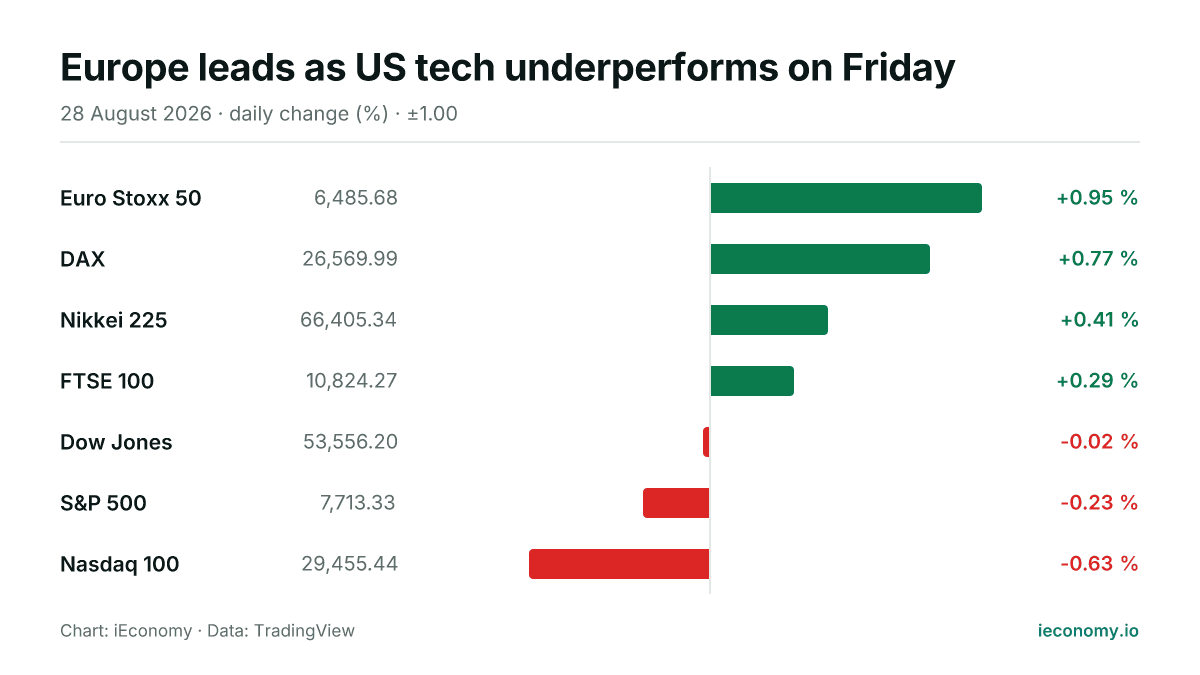
Europe leads as US tech underperforms on Friday
European and Asian benchmarks advanced on Friday, while the main US averages were mixed to weaker. The day’s moves were modest in the US and broader in Europe, leaving regional performance uneven.
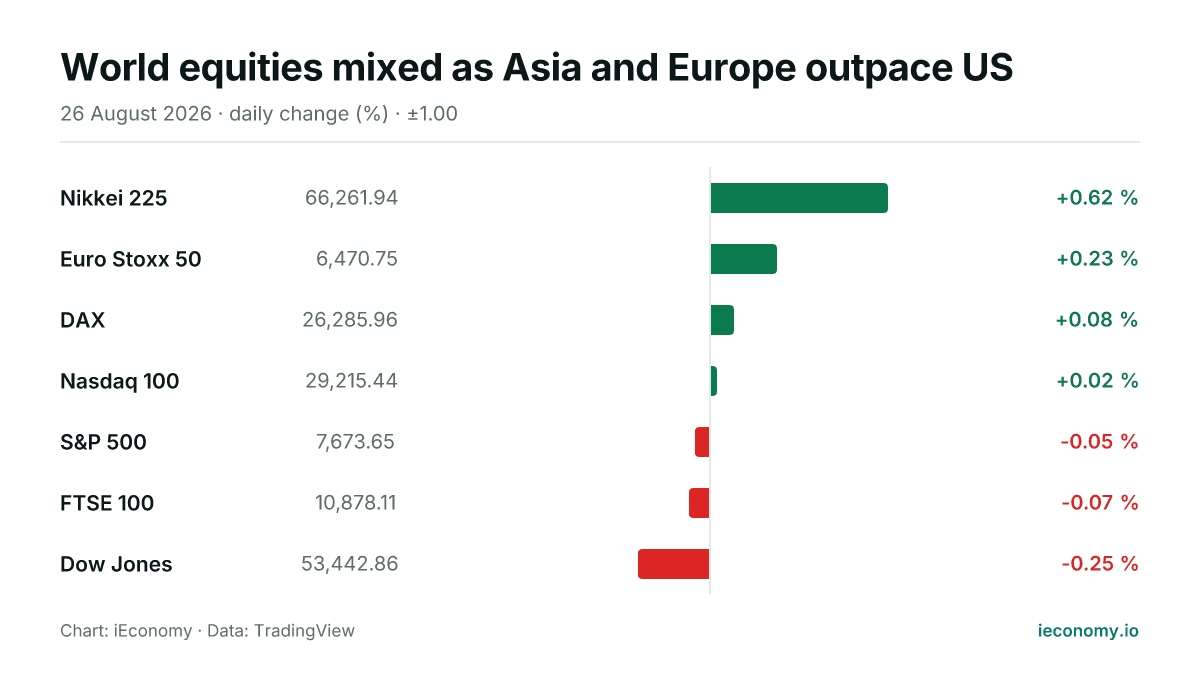
World equities mixed as Asia and Europe outpace US
Asian and European benchmarks edged higher as US indices were mixed in early trading. The moves were modest overall, with the Nikkei 225 leading and the Dow Jones the weakest in the group.
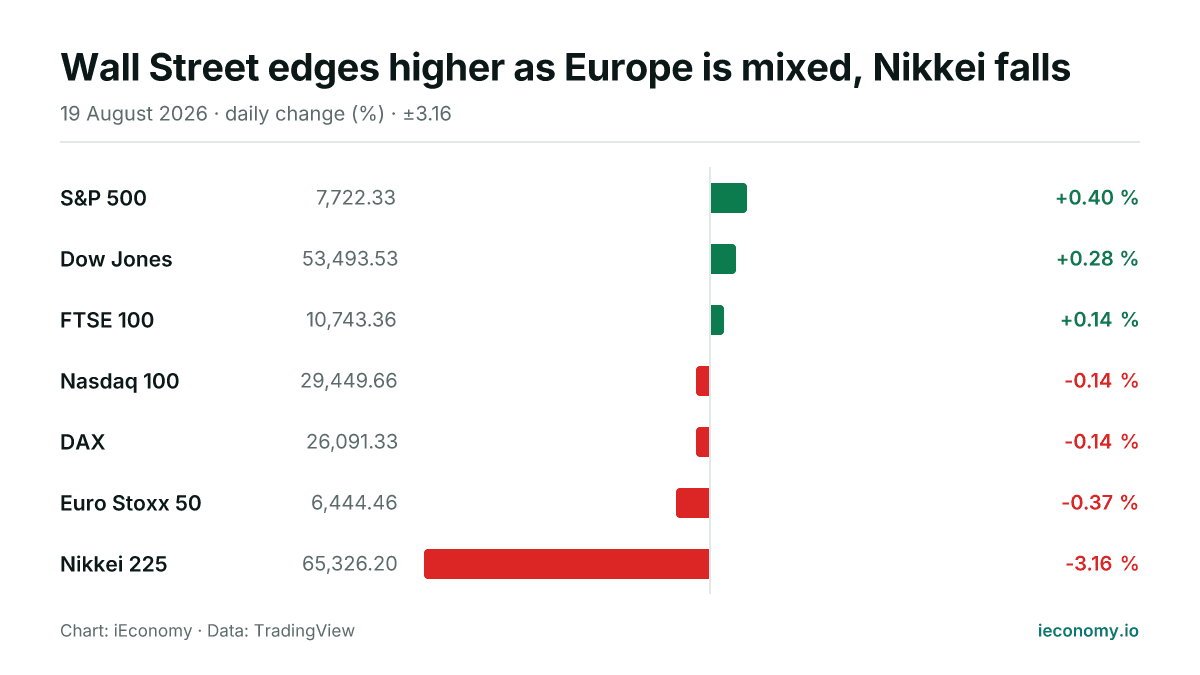
Wall Street edges higher as Europe is mixed, Nikkei falls
US equities were firmer in Wednesday trading, led by the S&P 500 and Dow Jones, while European indices were split and Japan’s Nikkei 225 lagged sharply. The session showed a broad but uneven risk appetite, with gains in some benchmarks offset by declines elsewhere.
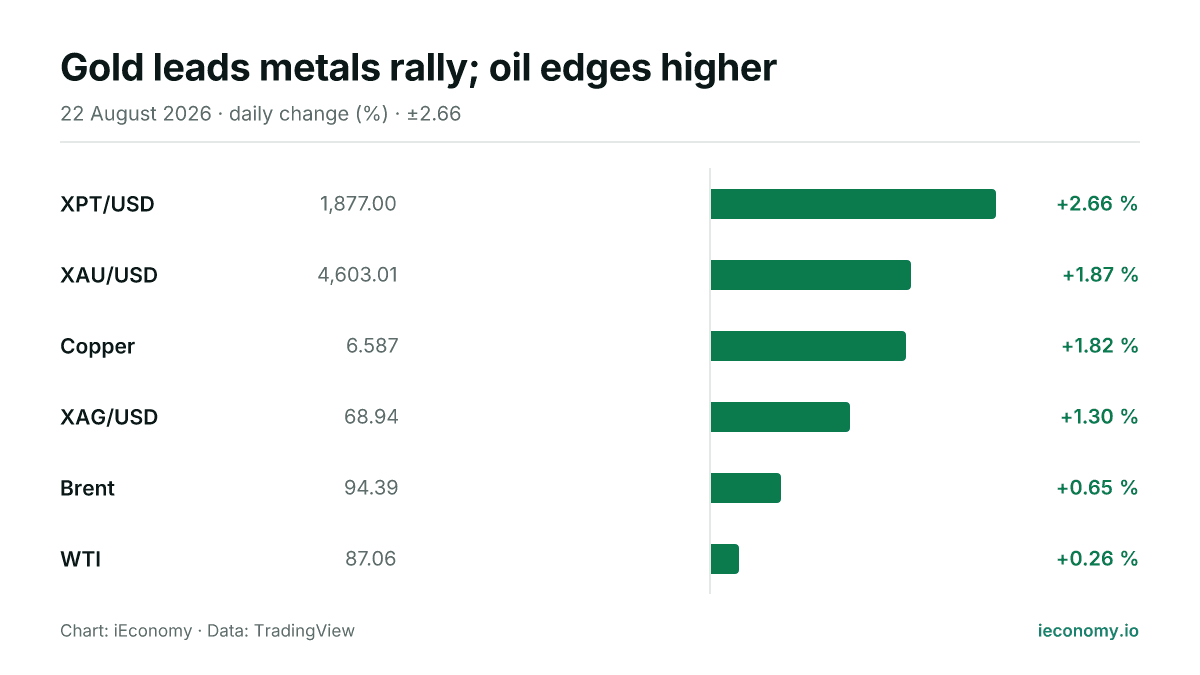
Gold leads metals rally; oil edges higher
Gold and silver advanced alongside crude oil in a broad commodity move on Saturday, with all six tracked instruments higher. Gold led the precious-metals complex, while Brent and WTI posted more modest gains.
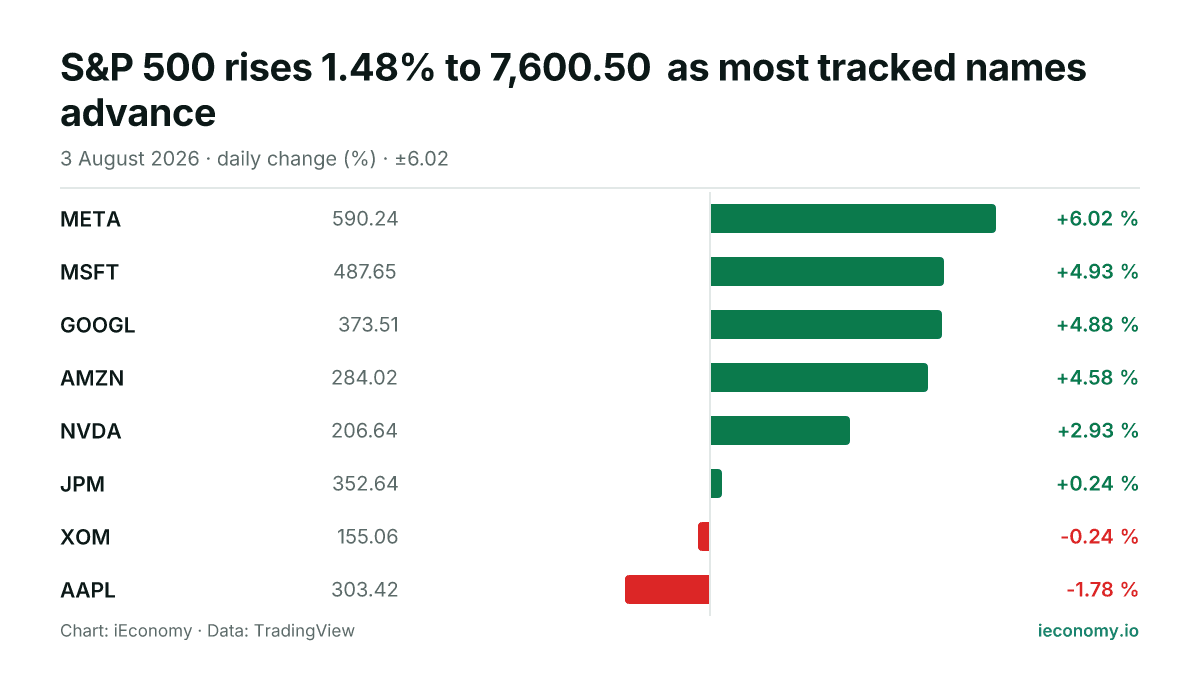
S&P 500 rises 1.48% to 7,600.50 as most tracked names advance
The S&P 500 finished Monday higher at 7,600.50, with six of the eight tracked constituents advancing. META was the strongest performer, while AAPL lagged.