US and Europe rise as Nikkei lags on Sunday
Most major equity benchmarks advanced on Sunday, with gains spread across the US and Europe. Asia was mixed, and the Nikkei 225 stood out on the downside.

Américo Toledano / Wikimedia Commons (cc-by-sa-4.0)
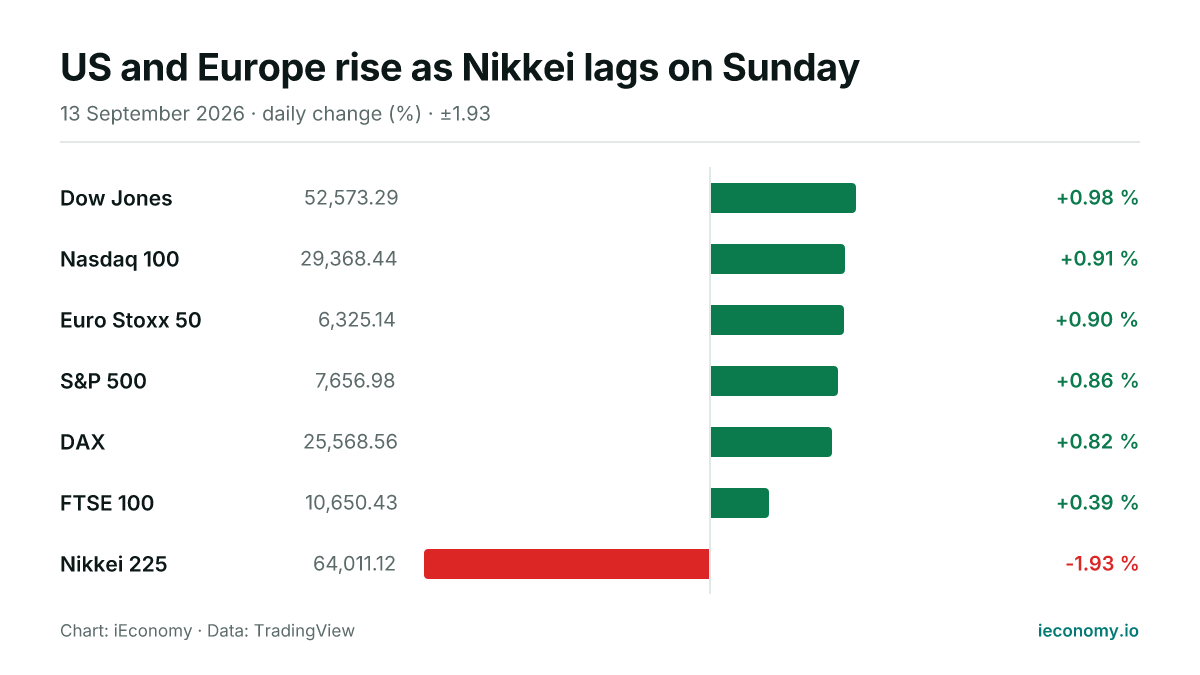
World equity markets were broadly firmer on Sunday, with six of the seven tracked benchmarks finishing higher. Gains were led by the Dow Jones and Nasdaq 100 in the US, while Europe also advanced; the Nikkei 225 was the only decliner and the clear outlier.
What moved and by how much
In the US, the Dow Jones rose 0.98% to 52,573.29 and the Nasdaq 100 added 0.91% to 29,368.44. The S&P 500 also moved higher, up 0.86%, leaving the main American gauges aligned on the day.
| Instrument | Last | Change |
|---|---|---|
| Dow Jones | 52,573.29 | +0.98 % |
| Nasdaq 100 | 29,368.44 | +0.91 % |
| Euro Stoxx 50 | 6,325.14 | +0.90 % |
| S&P 500 | 7,656.98 | +0.86 % |
| DAX | 25,568.56 | +0.82 % |
| FTSE 100 | 10,650.43 | +0.39 % |
| Nikkei 225 | 64,011.12 | -1.93 % |
European equities tracked the same direction. The Euro Stoxx 50 gained 0.90% to 6,325.14, the DAX added 0.82% and the FTSE 100 advanced 0.39%, a smaller move but still positive.
Asia did not follow the same pattern. The Nikkei 225 fell 1.93% to 64,011.12, making it the weakest instrument in the digest and the only index in negative territory.
The standouts at each end
The strongest move among the tracked indices was the Dow Jones, which edged ahead of the Nasdaq 100 and the European benchmarks. That matters because it shows the advance was not confined to one region or one style of equity exposure.
At the other end, the Nikkei 225 was the sole laggard by a clear margin. When one major index moves against a broad global advance, it can reflect session-specific positioning or local market mechanics rather than a uniform direction across world equities.
The FTSE 100 was the least dynamic of the risers, but it still stayed on the right side of flat. In a day dominated by positive readings, that sort of smaller gain can still contribute to a constructive overall tone.
What a long-term investor should take from one day
One session tells investors more about short-term market mechanics than about durable trends. When several large benchmarks rise together, it usually points to broad risk appetite or index-level buying, but the data here do not identify the underlying trigger.
The key perspective is that dispersion still matters. A single strong or weak day in one region, such as the Nikkei’s decline, can coexist with a wider global advance, which is why long-term decisions should rely on a run of observations rather than one print.
For portfolio holders, the practical lesson is to watch breadth as well as direction. Even when most indices are higher, differences between regions and between the most and least sensitive benchmarks can signal how evenly market gains are being distributed.
This article is not investment advice and recommends no asset, level or direction; a single session's move is not evidence of a trend. For background see Markets, Bear Market, BIST 100, and for terms the finance glossary.
Frequently asked questions
Was the day broadly positive for world equities?
Which index was the strongest performer? The Dow Jones was the best performer in percentage terms, rising 0.98%. The Nasdaq 100 and the Euro Stoxx 50 were close behind, which suggests a fairly balanced risk-on tone across regions.
Which index was the strongest performer?
What should investors focus on after a single session like this? Investors should focus on breadth, relative strength and consistency rather than assuming one day defines the trend. Single-session moves can be driven by positioning and trading mechanics, so they are best viewed as context, not conclusion.
Sources
Related News

Global equities ease; Nikkei edges higher
US and European indices were lower in Thursday trading, while Asia was mixed. The Nikkei 225 rose modestly, leaving one gain against six declines across the seven markets tracked.
Global equities slip across US, Europe and Asia
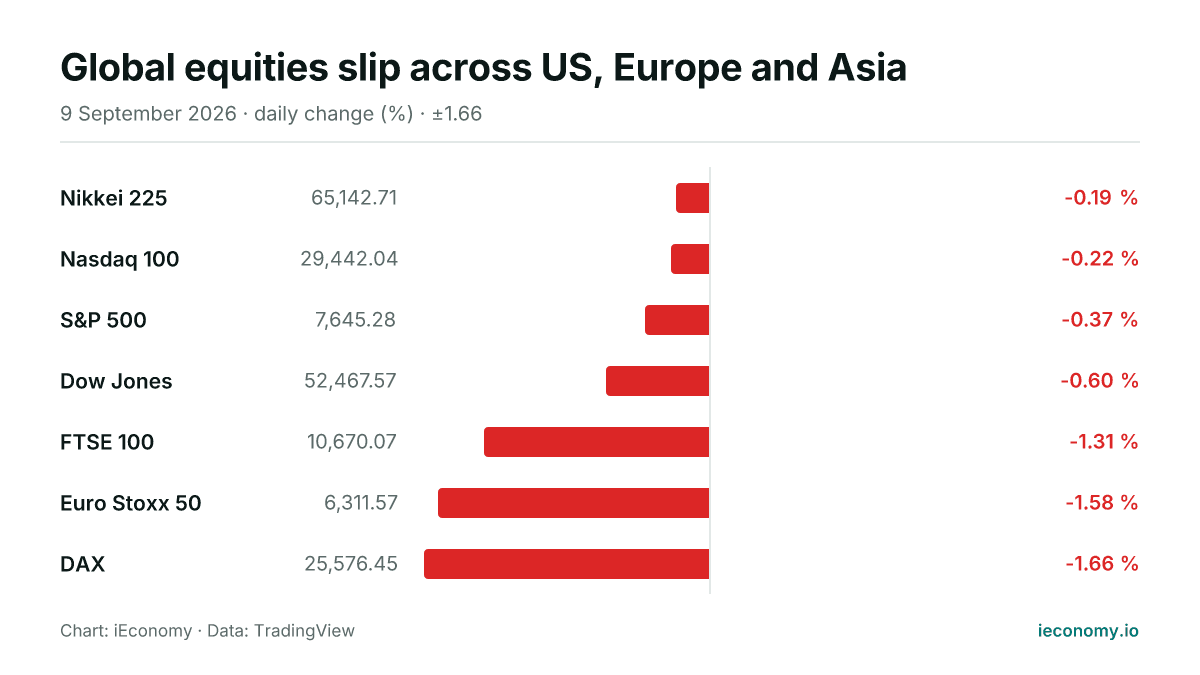
All seven tracked indices were lower or flat on Wednesday, with Europe leading the declines and the Dow among the weakest in the US. The session was broadly risk-off, but only the price action itself is visible here.
Nikkei leads as US stocks slip; Europe mixed
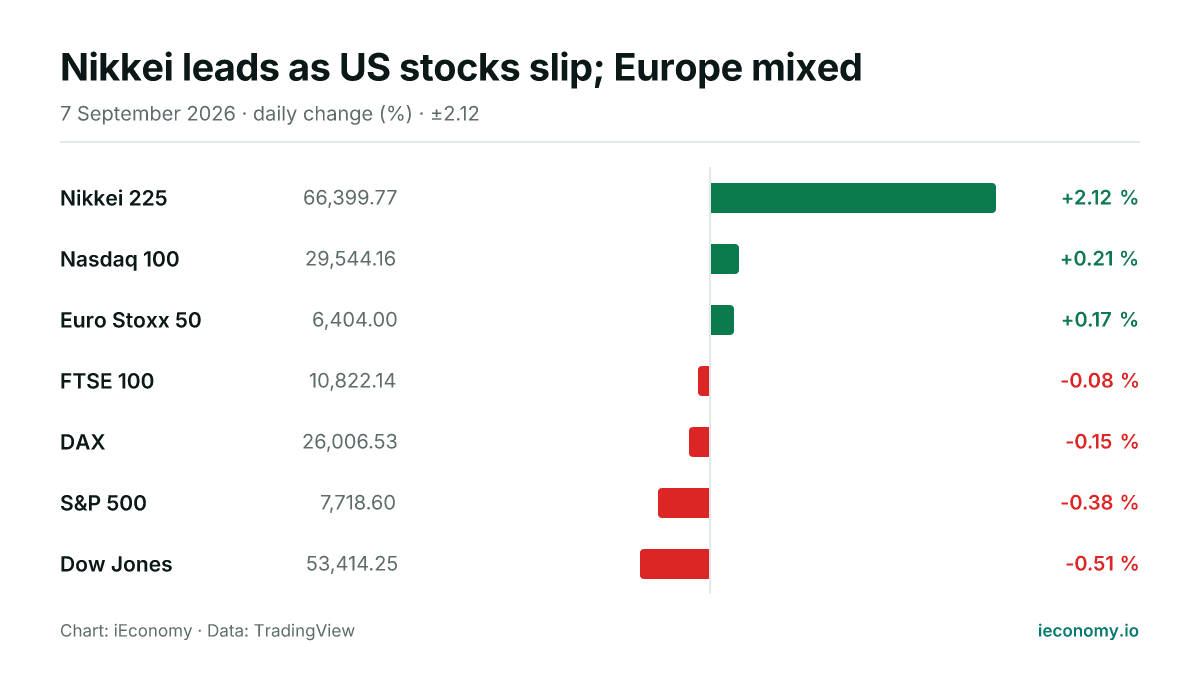
Asian equities outperformed on Monday, with the Nikkei 225 rising sharply while US benchmarks traded lower and Europe was mixed. The day’s moves were modest in most markets, but the gap between Japan and Wall Street stood out.
S&P 500 slips 0.48% to 7,636.36 in mixed trade
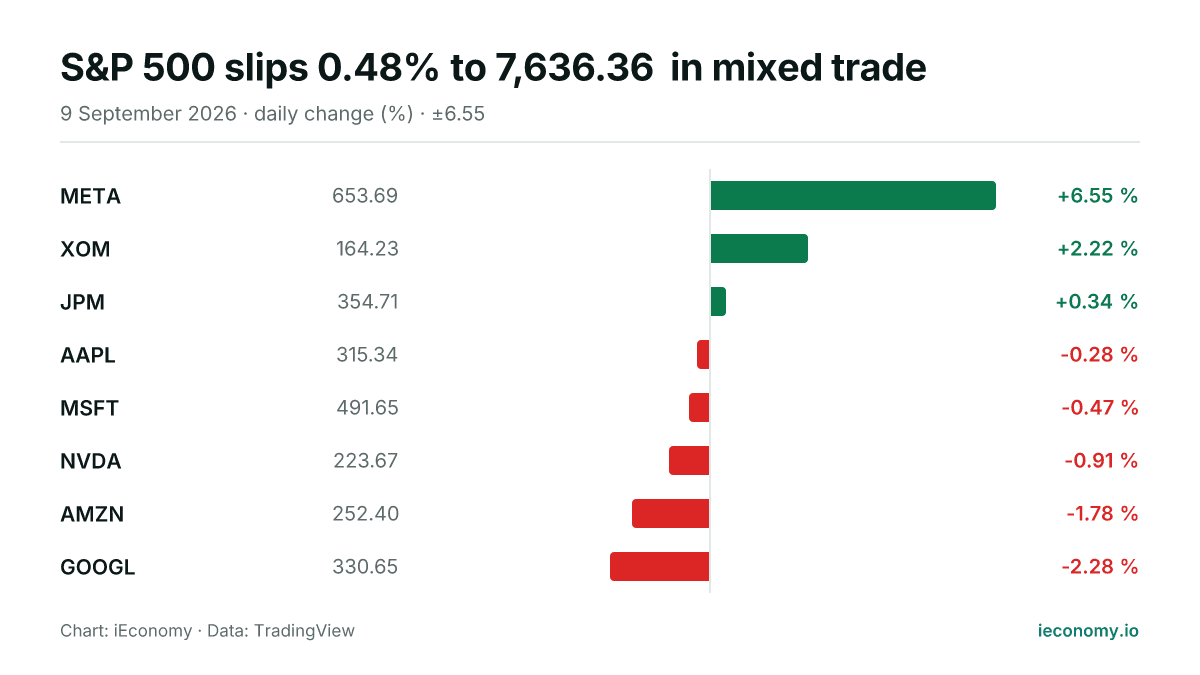
The S&P 500 ended the Wednesday, 2026-09-09 session lower, with 3 of 8 tracked constituents advancing and 5 declining. META was the best performer, while GOOGL was the weakest.
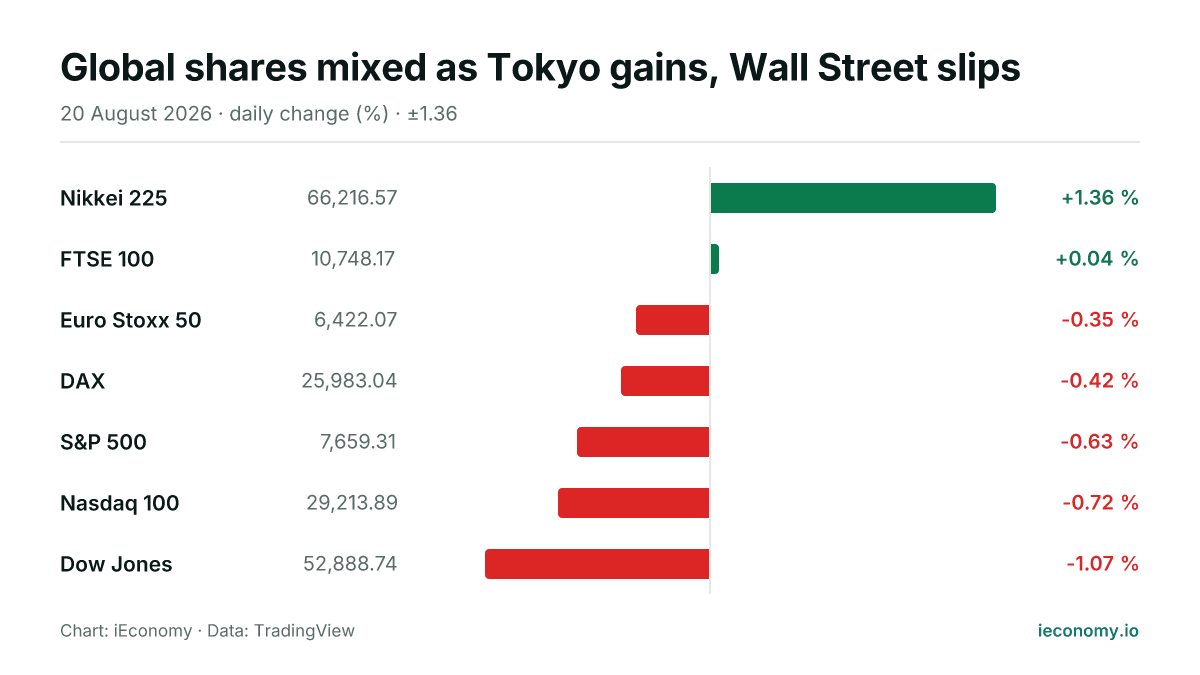
Global shares mixed as Tokyo gains, Wall Street slips
Asian equities were firmer and Europe was little changed to lower, while US indices traded lower. The day’s pattern showed rotation rather than a broad-risk selloff, with only two of seven benchmarks advancing.
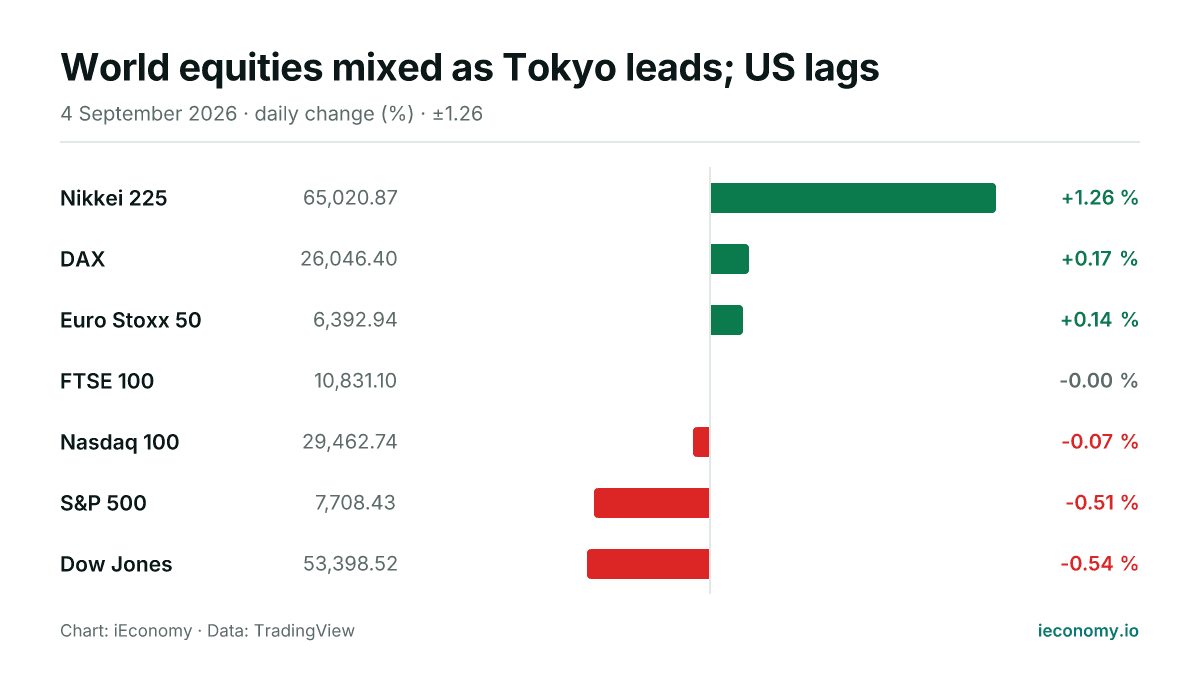
World equities mixed as Tokyo leads; US lags
Asian and European indices were mostly firmer on Friday, while US benchmarks finished lower in the digest. The move was uneven, with the Nikkei 225 the clear standout and the Dow Jones and S&P 500 among the weaker gauges.