S&P 500 edges higher as breadth stays slightly positive
The S&P 500 finished Friday at 7,411.98, up 0.05% on the session. The move was modest, with 5 of 8 tracked constituents higher and 3 lower.
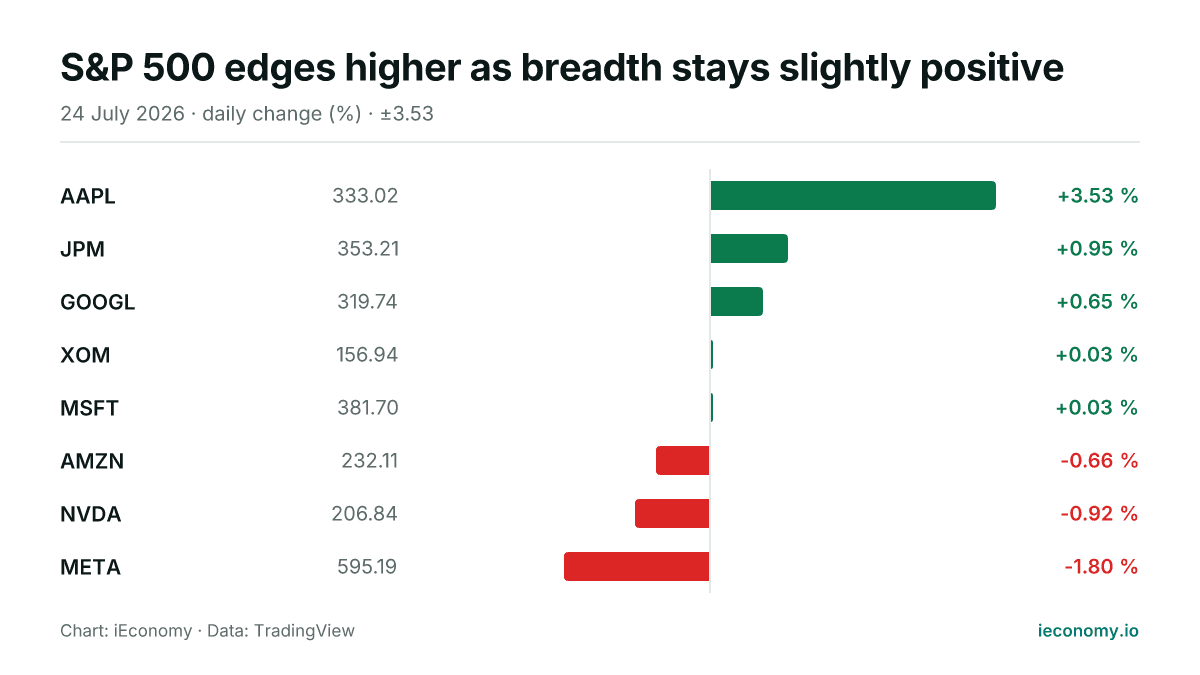
Chart: iEconomy · Data: TradingView
The S&P 500 ended Friday’s session marginally higher, adding 0.05% to close at 7,411.98. The advance was narrow but positive, with 5 of the 8 tracked constituents finishing in the green and 3 declining, leaving the index little changed overall.
How the index moved and how broad the move was
With the benchmark up only slightly, the session was driven more by incremental gains than by a broad-based surge. The breadth figures matter here: a majority of the tracked names advanced, but not enough to produce a decisive index move. In index terms, that usually means individual stock performance was offsetting rather than aligning, so the headline result remained close to flat even with more winners than losers.
| Stock | Last | Change |
|---|---|---|
| AAPL | 333.02 | +3.53 % |
| JPM | 353.21 | +0.95 % |
| GOOGL | 319.74 | +0.65 % |
| XOM | 156.94 | +0.03 % |
| MSFT | 381.70 | +0.03 % |
| AMZN | 232.11 | -0.66 % |
| NVDA | 206.84 | -0.92 % |
| META | 595.19 | -1.80 % |
Standout individual performers
Apple was the strongest performer among the tracked constituents, rising 3.53% to 333.02. At the other end, Meta was the weakest, falling 1.80% to 595.19. Those moves illustrate how a single large constituent can stand out materially even when the broader index barely moves. In a cap-weighted benchmark like the S&P 500, such dispersion can shape the session’s tone without necessarily determining the final index direction on its own.
What a long-term investor should take from one session
One day’s performance tells more about short-term trading mechanics than about a durable trend. When breadth is mixed and the index barely moves, it often reflects rotation, stock-specific repositioning or simple balancing between gainers and decliners rather than a clear shift in the market’s underlying structure. For long-term investors, the key takeaway is to distinguish between daily noise and persistent pattern: a single session can highlight dispersion and sensitivity among large constituents, but it does not by itself establish a broader regime change. The main risk in reading too much into a move this small is overinterpreting routine volatility as signal.
Related News
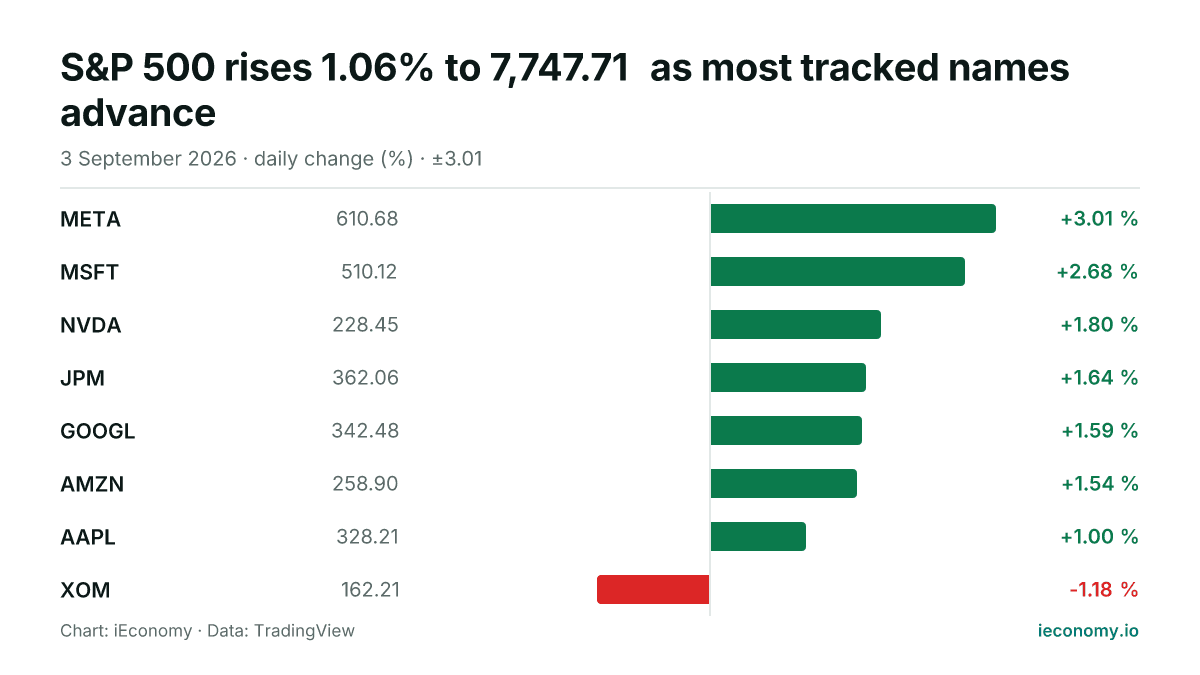
S&P 500 rises 1.06% to 7,747.71 as most tracked names advance
The S&P 500 finished Thursday higher, with 7 of 8 tracked constituents in positive territory. META was the strongest performer, while XOM was the only decliner among the names tracked in the digest.
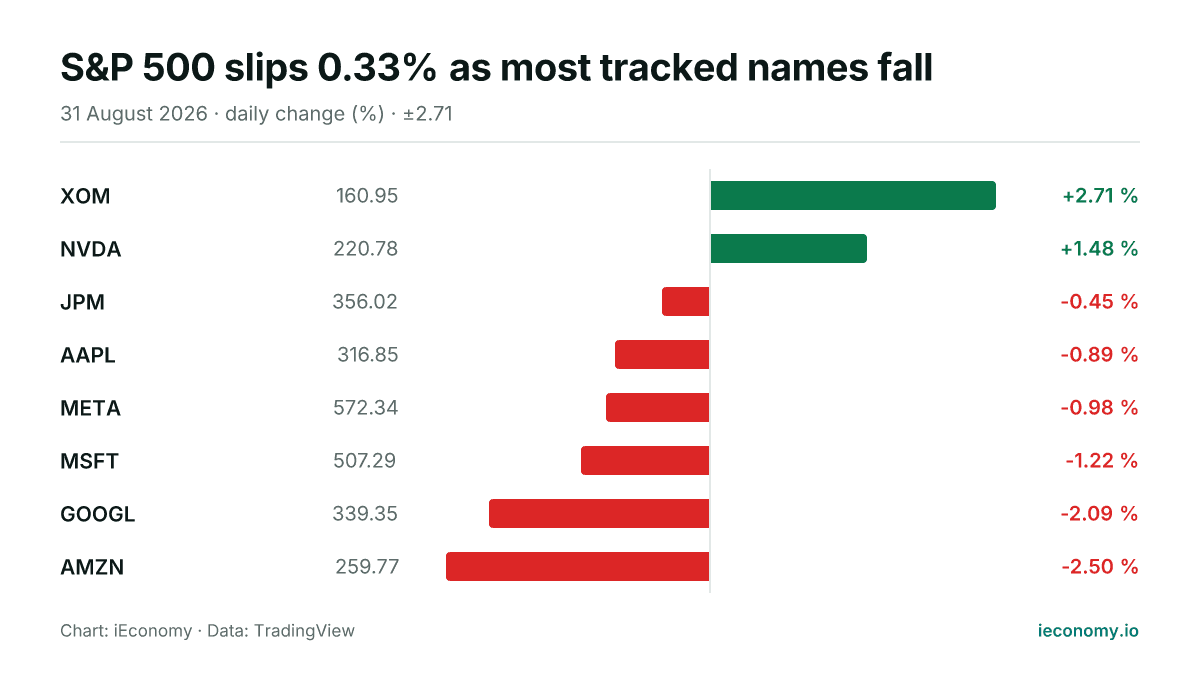
S&P 500 slips 0.33% as most tracked names fall
The S&P 500 ended Monday at 7,686.14, down 0.33% on the session. In the small set of tracked constituents, six fell and two rose, with Exxon Mobil the strongest and Amazon the weakest.
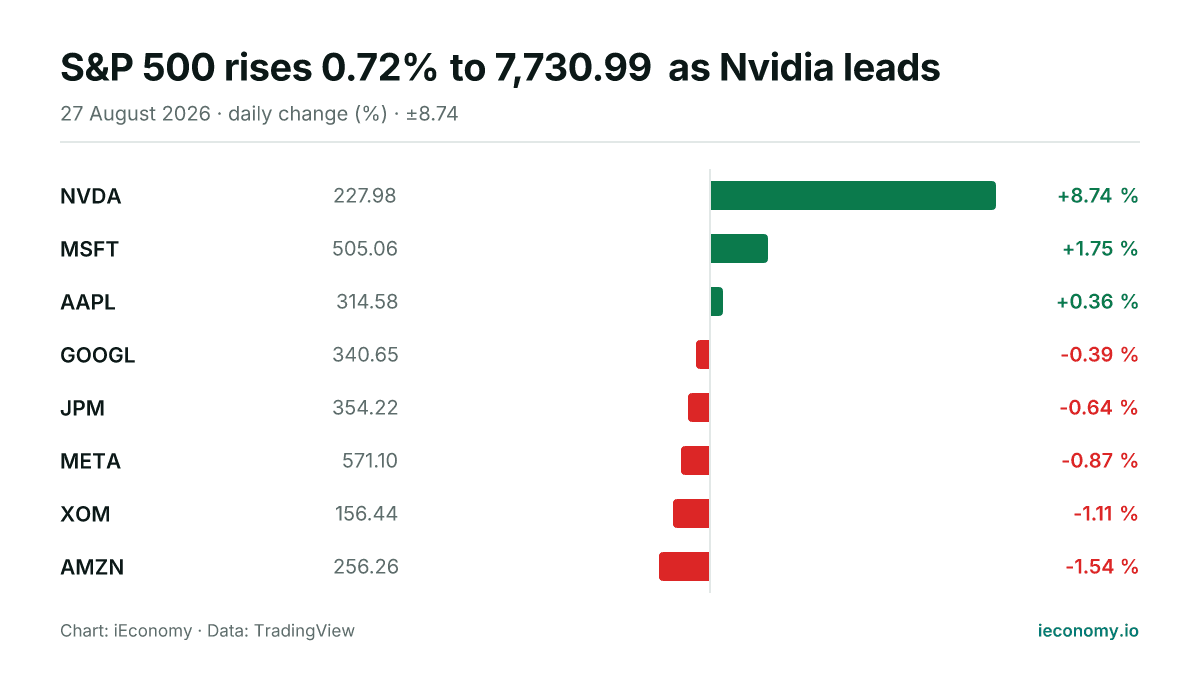
S&P 500 rises 0.72% to 7,730.99 as Nvidia leads
The S&P 500 advanced on Thursday, with a narrow majority of tracked constituents higher. Nvidia was the strongest performer, while Amazon lagged the group.
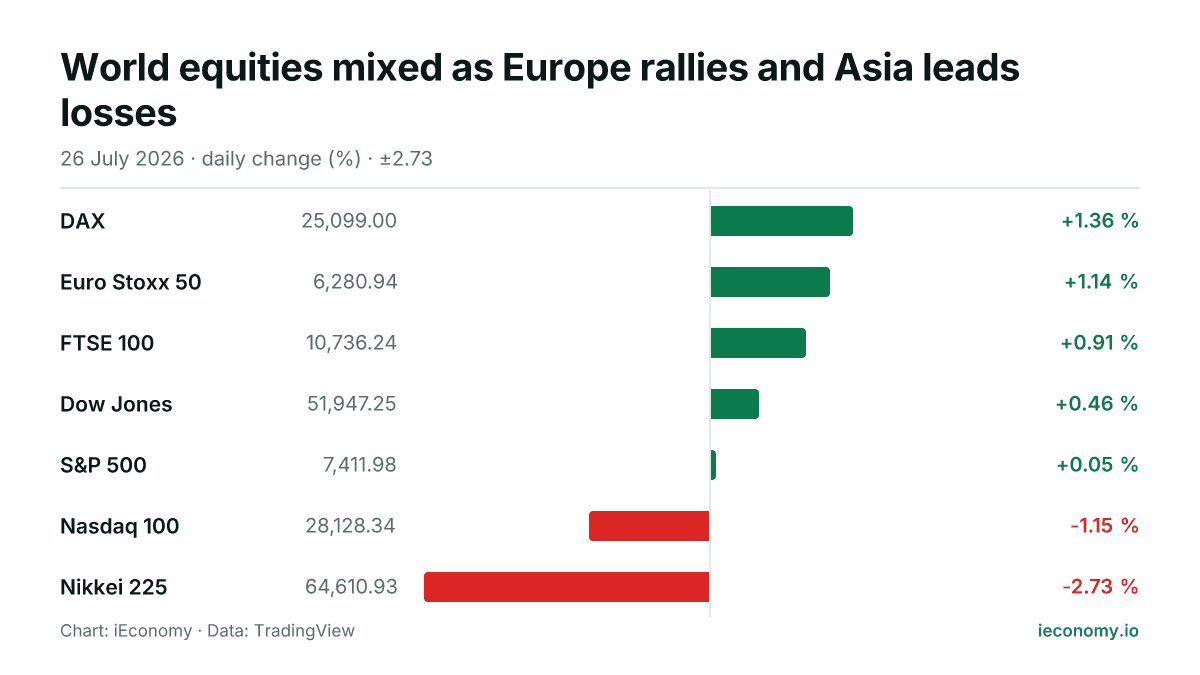
World equities mixed as Europe rallies and Asia leads losses
European benchmarks advanced while US indexes were broadly firmer and Asia finished lower, with the Nasdaq 100 and Nikkei 225 lagging. The day left 5 of 7 tracked indices higher, but the dispersion was wide.
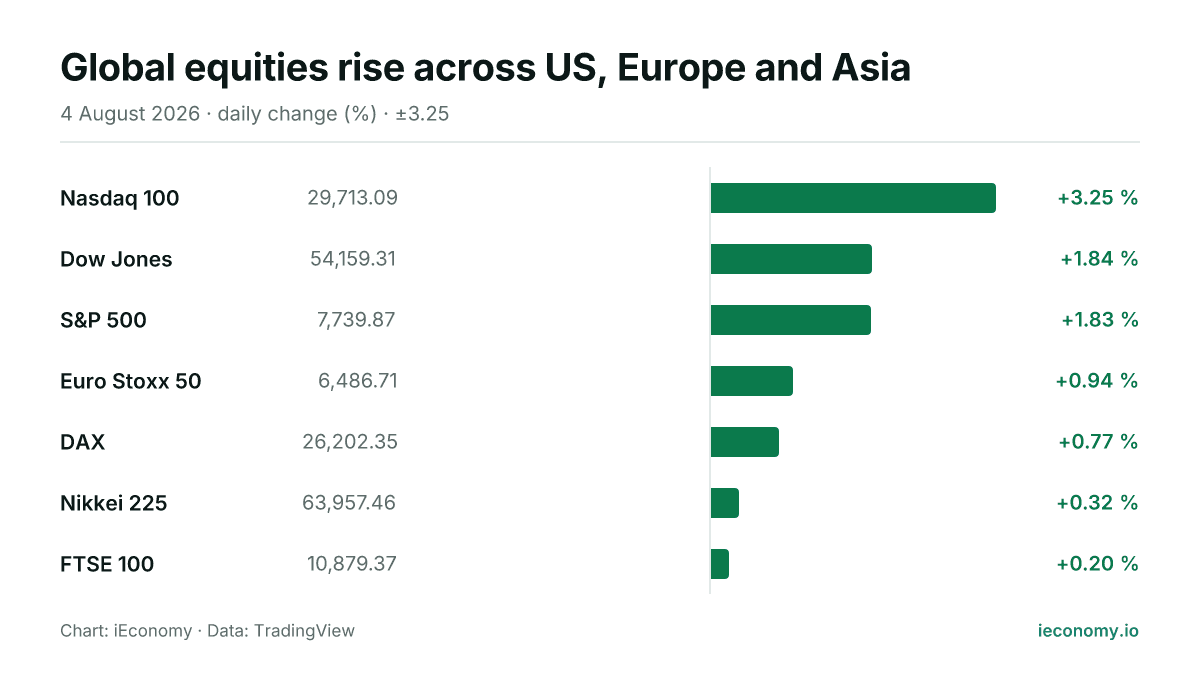
Global equities rise across US, Europe and Asia
All seven tracked equity benchmarks finished higher in the digest, led by the Nasdaq 100. Gains were broad-based across the US, Europe and Asia, with no index flat or lower.
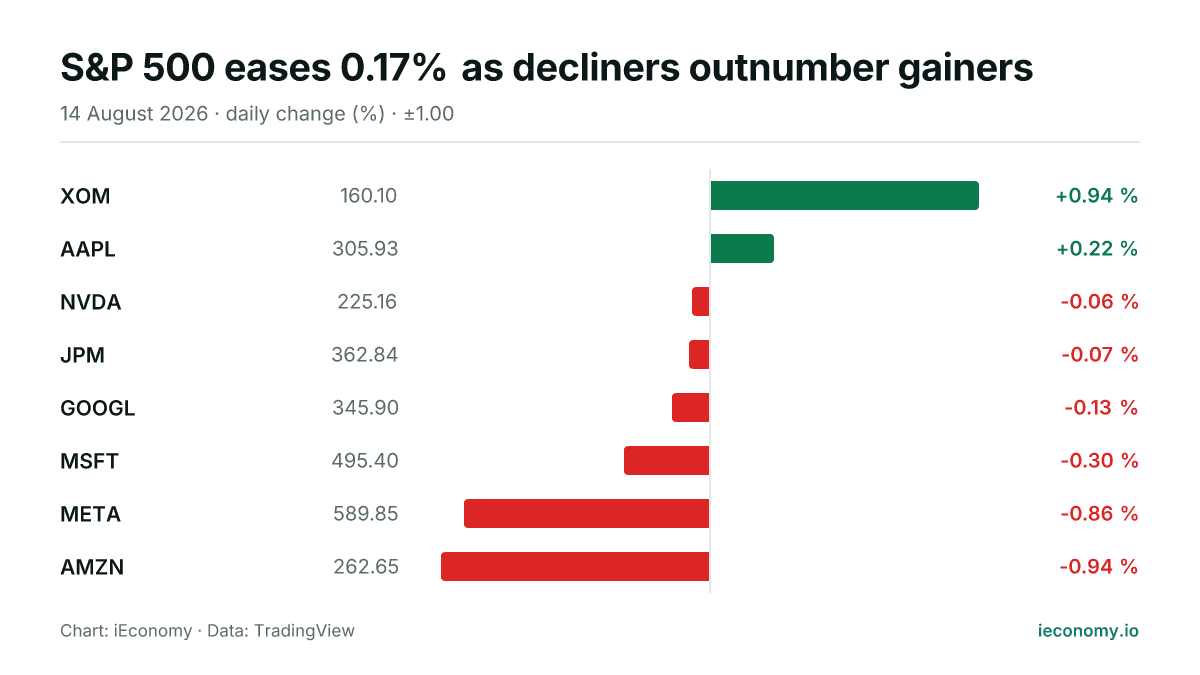
S&P 500 eases 0.17% as decliners outnumber gainers
The S&P 500 finished Friday at 7,785.76, down 0.17%, with six of the eight tracked constituents lower. XOM was the strongest performer, while AMZN lagged.