What Is Inflation? CPI, Core Inflation and Purchasing Power
What causes inflation, how CPI and PPI actually measure it, who loses the most, and how central banks use interest rates to fight it.
If the same grocery basket costs more every month, you already know this feeling. It has a name: inflation. In plain terms, it means your money buys less than it used to. Statistical agencies track thousands of prices each month. They compress those prices into one number. That number is the inflation rate you see in the news.
This guide explains how inflation starts. It shows how inflation is measured, and why official figures sometimes get questioned. You will not find today's rate here. That number changes every month. We point you to where to check it near the end.
The goal is not to hand you a number to memorize. It is to show you what sits behind the CPI figure in the news. You will learn who publishes it and why economists sometimes argue about it. The next inflation headline you read will actually mean something.
What Causes Inflation? Demand-Pull, Cost-Push and Expectations
Demand-pull inflation shows up when people want to buy more than the economy can produce. Supply stays roughly fixed. Buyers compete for it, and prices climb. A neighborhood where housing demand jumps, but new building lags, is a clean example. Rents rise fast because more people want in than there is room for.
Cost-push inflation works the other way: costs rise first. Energy, raw materials or wages get more expensive. Businesses pass that cost on rather than absorb it. When global energy prices spike, almost every industry feels it at once. Energy touches transport, factories and heating alike.
Expectations add a third channel. This one is more a habit than a mechanism. Once people believe prices will keep rising, workers push for higher pay. Firms raise prices early to protect their margins. The cycle then feeds itself. Breaking that habit takes longer than starting it. An economy that lived through years of high inflation does not trust a lower number right away, even once the pressure has actually eased.
Money supply plays a role too. When the money in an economy grows much faster than its goods and services, more currency chases the same shelf of products. Central banks sometimes expand the money supply directly, through large-scale asset purchases. That tool can support markets in a downturn. But it adds to inflation risk if it runs for too long.
How Is Inflation Measured? CPI, PPI and Core Inflation
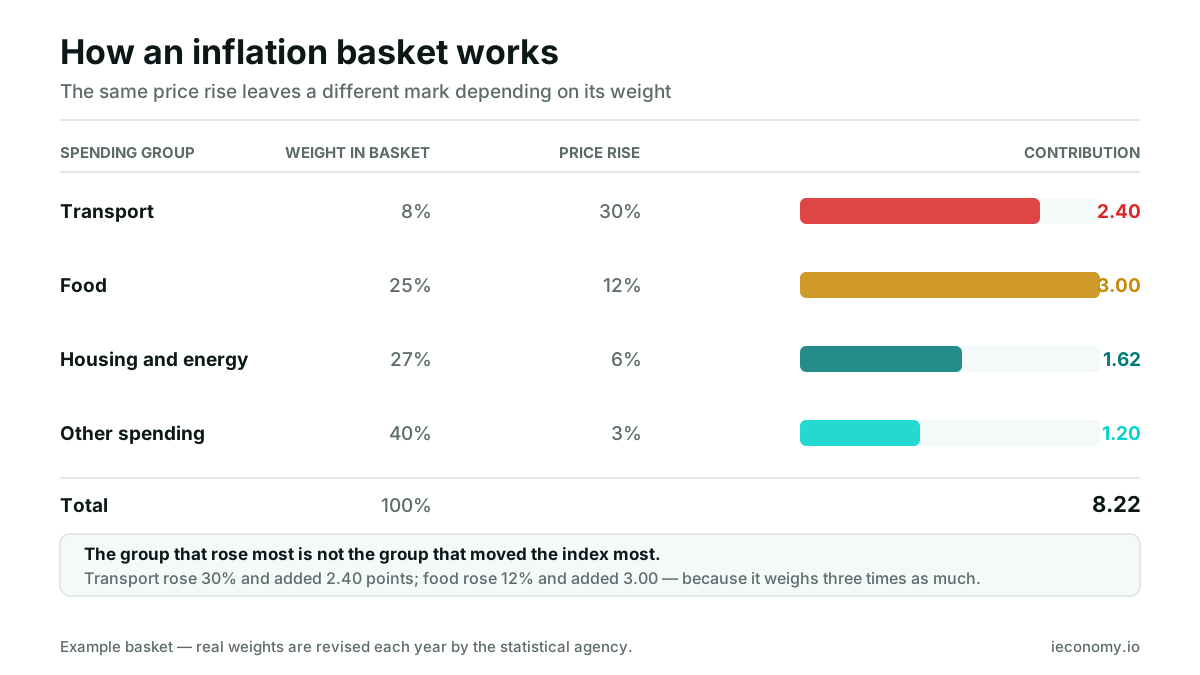
Statistical agencies build a representative "basket" of everyday goods and services: food, rent, transport, clothing. They price that basket every month. The change in its cost is the Consumer Price Index. This is the number most people mean when they say "inflation."
Not every item in the basket carries the same weight. The European Central Bank's own explainer gives a clean example. Petrol carries roughly ten times the weight of coffee in the eurozone basket. So the same percentage price move in petrol shifts the index far more than an identical move in coffee. Weights come from household spending surveys. They get updated as spending habits change.
The Producer Price Index measures a different point in the chain. It tracks what factories and wholesalers charge when goods first leave the production line. PPI usually moves before CPI. A producer facing higher costs raises its own price first, and that increase reaches store shelves only months later. A widening gap between the two indexes is often an early signal of where consumer prices are headed.
Core inflation strips out food and energy. These two categories swing hardest for reasons that have nothing to do with real demand, like a cold snap or a shipping delay. Central banks lean on the core figure for a simple reason: interest rate decisions take months to show up in the economy. Reacting to one bad month would be a mistake.
The mirror image of inflation is deflation. Prices fall, and money buys more over time. That sounds appealing until you see what it does to behavior. If a product will be cheaper next month, buying it today makes less sense. Purchases get delayed, and demand weakens further. That is why most central banks, including the Federal Reserve, target a low positive rate — commonly 2% — rather than zero.
The basket itself is not frozen either. Statistical agencies revise it on a regular cycle. Items nobody buys anymore drop out. New categories, like streaming subscriptions, get added once spending on them becomes real. A basket that never updated would drift further from real habits every year.
Why Do Official Inflation Numbers Get Challenged?
Two economies can have genuinely different inflation and still be measuring the same idea with different rulers. That is exactly why comparing national CPI figures across countries is trickier than it looks.
Basket contents and item weights differ by country. Each country draws them from its own household spending surveys. A country where housing eats a bigger share of the budget will see its index move more with every rent increase, compared with one where housing carries a smaller weight.
Geographic coverage and collection method matter too. How many cities get sampled, how often prices get checked, and whether that happens in person, by phone or online — all of it shifts the final number slightly. The euro area solved exactly this problem by building the HICP. It is one harmonised method applied the same way in every member state, so the European Central Bank can compare inflation in Germany and Portugal on equal terms.
None of this means one country's number is wrong and another's is right. It means two statisticians using a different ruler on the same economy will not land on an identical figure. Once you know that, a gap between two credible sources stops looking like a scandal. It starts looking like methodology.
How Does Inflation Affect Your Life? A Simple Example
Say inflation runs at 5% a year, purely as an example. A grocery run that cost $100 last year costs $105 this year, for the exact same items. If your income has not moved, that extra five dollars has to come from somewhere else in your budget.
This erosion hits fixed incomes hardest: a pension, a fixed-rate bond, a savings account paying a flat rate. If the payout does not rise with prices, its real value shrinks every year. That happens even while the number on the statement stays exactly the same. The same logic applies to dividend income that never grows. A flat payout is a shrinking payout, in real terms.
Renters and landlords feel the same inflation on different timelines. Rent stays fixed for the length of a lease. Then it jumps all at once at renewal, to catch up with everything that built up in between. That is why tenants tend to feel inflation as a sudden shock, not a gradual squeeze.
Debt runs the other way. A fixed-rate loan's real burden gets lighter as inflation rises. The money paid back years later is worth less than the money originally borrowed. Inflation quietly shifts value from lenders to borrowers. Nobody signs a contract for that, but it happens anyway.
This is part of why some savers move cash into foreign currency, gold, or inflation-linked instruments during high-inflation periods. The goal is not outsized gains. It is to limit how much a weakening currency erodes their savings. In the US, for instance, I bonds are built so their rate adjusts with CPI, a design made specifically for this problem. None of this is a recommendation. Every instrument carries its own risk, and the exchange rate itself moves for reasons well beyond inflation alone.
How Do Central Banks Fight Inflation? The Interest Rate Channel
There is no single switch that turns inflation off. What a central bank has is a lever: interest rates. Raise them, and credit gets more expensive. Spending and investment slow, and demand cools. Cooler demand takes the pressure off prices.
The credit channel moves first. Mortgage rates, auto loans and credit card rates shift within weeks of a policy decision, well before the wider economy adjusts. A household weighing a new loan thinks twice. That hesitation, repeated across millions of households, is what actually throttles spending.
The full effect is slow. A rate move usually takes several months to show up in measurable inflation, sometimes closer to a year. That lag is why central banks watch core inflation and survey-based expectations, rather than react to a single monthly print.
This trade-off is real. Push rates up too far, and demand does not just cool, it stalls. That can tip the economy toward a recession. Central banks weigh that risk against the cost of letting inflation run. Reasonable economists land in different places on where that line sits. This article does not forecast where any policy rate is headed. It explains the mechanism, not the call. Readers who want the deeper mechanics of how central banks set interest rates can find it in that guide.
Where Can You Check the Current Inflation Rate?
This page deliberately carries no live number. A hardcoded figure would be wrong within a month. An evergreen explainer that tries to double as news just ages badly.
The right first stop is always the statistical agency that compiles the number for your own economy. Its release calendar is public and scheduled well in advance. The publication date is never a surprise, even if the figure itself is. For the eurozone specifically, that agency publishes through the European Central Bank's own HICP data.
Interest rate decisions are the main policy response to that data. Our interest rate decision calendar tracks upcoming central bank meeting dates. It shows you when the next reaction to fresh inflation data is actually scheduled.
Frequently asked questions
The questions readers ask most often about inflation, answered in plain terms below.
What is inflation in simple terms?
Inflation is a broad, sustained rise in the prices of goods and services across an economy. It is not just one product getting more expensive. As prices climb, each unit of currency buys less than it used to. That is why it is called a loss of purchasing power.
What is the difference between inflation and deflation?
Inflation is a general rise in prices. Deflation is a general fall. Money loses purchasing power during inflation and gains it during deflation. Both turn damaging in their extreme forms. Deflation delays spending; runaway inflation destroys savings and planning.
What is the difference between CPI and PPI?
CPI tracks what consumers pay at the till. PPI tracks what producers charge when goods first leave the factory. A rise in PPI often shows up in CPI a few months later, because producers eventually pass higher costs on to shoppers.
Why do central banks track core inflation separately?
Core inflation removes food and energy. These are the categories most likely to swing sharply for reasons unrelated to real demand. That separation lets policymakers judge whether price pressure is a lasting trend or a short-lived shock, before they adjust interest rates.
Is inflation always bad?
No. Low, steady and predictable inflation is what most central banks actually target. It is a normal feature of a growing economy. The problem is inflation that turns high, volatile or unpredictable, because that is what makes it impossible for households and businesses to plan ahead.
Is cost of living the same thing as inflation?
Not exactly. Inflation is a measured, published rate based on a standard basket of goods. Cost of living is what one person actually feels in their own budget. That depends on their personal spending mix. The two overlap, but rarely match exactly, because no one's spending looks exactly like the official basket.
How can I protect my savings from inflation?
That depends on your personal financial situation, time horizon and risk tolerance. It is beyond what this article can responsibly answer. What matters here is understanding what inflation is and how it is measured. Which instrument, if any, protects your specific savings is a decision that needs individual financial advice, not a generic answer.
Sources
iEconomy Academy
This article is a lesson in: Foundations · Lesson 1/5
Related News

Candlestick Patterns: Chart Formations and What They Mean
Single, two and three-candle patterns — doji, hammer, bullish engulfing, morning star — with the structure of each, the trend it is looked for in, and an original diagram for every one.

Stock Market Hours and Holidays: NYSE and Nasdaq Guide
A clear reference to regular U.S. stock market hours, pre-market and after-hours trading, early closes, holiday closures, and how bond-market holidays differ.

How to Cash In Savings Bonds: Electronic and Paper
Learn how to redeem U.S. savings bonds through TreasuryDirect or a bank, when penalties apply, how partial redemptions work, and what to do with inherited or lost bonds.
How to Read Cryptocurrency Charts?
As crypto assets continue to be followed with interest all over the world, investors often use charts to open and close positions...
How to Evaluate a Stock Before Buying
A practical framework for judging a company’s business model, financial strength, valuation, and key risks before you invest, without relying on headlines or tips.
What is the MACD Indicator?
What is the MACD Indicator? How to Calculate MACD?How to Add a MACD Indicator?The MACD indicator, was developed by Gerald Appel in the 1970s.